It’s All Relative
The boyz from Hot Knives went ape for a box of Founders. They mistakenly confused their booty for the entire lineup[1], but how were these west coasters to know?
Anyway, it’s interesting to hear their take on the beers. For the most part, they know what they’re drinking. The hoppy beers are balanced and lie more east than west when it comes to IPA character[2]. However, where Founders gets it right every time is with their stouts, imperial stouts even. Overall, they were stoked to get something so rare…for LA.

This got me thinking about how regions can have completely different takes on the same products. Founders is based out of Michigan and generally only ships to states in the Great Lakes region along with Missouri and a few other eastern states. To those of us in Missouri, they’re fairly common[3], to the point that a few of these beers are considered disappointments on particular years[4].
The love for regional beers or music by those outside said region is always interesting to me. Beers and bands enjoy a certain kind of love close to home, some genuine and some obligatory. It’s more of an ownership thing that’s tempered by familiarity. A brewery or band succeeds when they get all kinds of love from outside of their homes, love that is based on performance and not just hype.
In the above video, the hipsters[5] were excited by Founders’ hype on the west coast, but they were won over by the imperial stouts. Still, I wonder what the reaction would have been if Founders wasn’t all that good at brewing beer. I know that I’ve had some hyped beers from out of market and were somewhat letdown. Conversely, I’ve had others that did not disappoint, living up to and sometimes passing the hype. In the end, how the beer tasted, looked, and smelled won me over, not the hype associated with a scarcity based on regional distribution/limitations.
This is where I was reminded to appreciate what a rare treat it is that we in Missouri get great beers from Michigan (Founders, Jolly Pumpkin, Bells, etc.), Colorado (Avery, Great Divide, Ska, etc.), New York (Southern Tier, Schmaltz), California (Green Flash, Firestone Walker, Stone, etc.), the Pacific Northwest (Deschutes, Caldera, etc.), as well as places in between and from our own state (Schlafly, Boulevard). However, sometimes it takes an outsider’s appreciation to do the reminding.
Relatively speaking, Founders is pretty common around these parts. However, it’s probably a jolt to these LA food/beer bloggers. It’s the same when someone here shows up with something from Russian River, Three Floyds, or Dogfish Head – all breweries not commonly available in the Show-Me state. Although these breweries are great no matter where you are, they are even that much better where they are not normally found.
It reminds me of the time I saw Guided By Voices play on Coney Island. One summer weekend, a few of us drove all night to see them play in the inaugural Village Voice Siren Fest. As we rolled our collective eyes over the showmanship of the band, the crowd of New Yorkers went completely nuts for windmills and epic kicks.
See, living in Ohio during the 90’s and half of the last decade, one had many opportunities to see GBV in all its glory. I saw or could have seen the band play on every tour from Bee Thousand through Half Smiles of the Decomposed, plus special gigs in between[5]. So, their shtick was pretty played-out for us by then.
The difference was that New York had not been able to experience nearly as much Bob Pollard as we Ohioans had[6]. To them, it was all new or at least novel. To us, it was the last decade+ and we were ready to move on, forgetting how much we loved GBV and all those shows and all the theatrics we now detested. So, GBV’s popularity that day was mostly relative to them performing in front of a crowd not blessed to see them all that often[7].
Anyway, a good reason to keep beer distribution regional and small is the joy we get when we have a beer out of market, like the Hot Knives boys and their box of Founders. Some of the enjoyment we have – whether it’s beer or music – is relative to where we are, what’s normally available there, and with whom we’re sharing the experience.
I’m glad someone in LA got to try some Founders. They now know what the midwest has to offer that west coast IPA’s cannot always fulfill. I’m also glad that this video reminded me of what a nice craft beer option we have here in Middle Missouri with Founders in almost every grocery, restaurant, and bar.
Notes:
1 It was a nice haul, but there are a few key bottles missing: Cherise, Pale Ale, Dirty Bastard, Red’s Rye PA, Porter, All Day IPA, Curmudgeon, Harvest Ale, and Backwoods Bastard. Plus, there are the super rare bottles like CBS, Better Half, and Blushing Monk.
2 With my limited palate, I am finding that I prefer the West Coast IPA to those of the east. A “balanced” IPA seems to be code for “tons of sweetness to balance out all the hops.” I’m growing a bit weary over Eastern and Midwestern DIPA’s. The IPA’s are fine. It just seems there’s way too much sweetness going on.
3 Of course, this has only been the case for a few years. Founders was one of the first big craft brewers to plunge into Missouri’s waters. Since then, it’s been an avalanche of new beer.
4 The Devil Dancer just didn’t do it for me this year. I blame the ridiculous amount of hops needed for a triple IPA (whatever that is). If the crop this year was even a tiny bit off, it affected the whole beer. Also, I really don’t care for fresh KBS. That beer needs a year to age before it’s good.
5 I once saw them play a tent in Dayton on a snowy St. Pat’s Day. My brother got us kicked out.
6 Guided By Voices gigs and things like cow tipping are probably the only two things that Ohio can say they get more opportunities to do than New Yorkers.
7 See #6. Why do I even have this footnote?
Another note…The use of “hipsters” as a descriptor was not meant as an insult. Hipsters tend to be creative and fashionable types. What’s not to like about that?
Beer Porn
“Oh yeah. I’ve come to fill your glass…”
I, like many of you, love a good bit of beer porn. However, rarely does said porn come in a video that reminds us of…well…porn.
Someone should show the following to advertisers who think they know how to make beer ads sexy. This is all we really want: the beer, not the sex. Well, the sex is good too.
What I mean to say is that the true beer lover prefers beer for the sake of beer and not for the fantasy certain corporate producers of industrial, rice-adjunct lager try to sell us. Just give me that good old fashioned beer porn! (H/T Brewpublic)
Goose Island Is Beer’s Sub Pop, Matador
Folks were worried that Goose Island was ruined forever when they sold out to AB-InBev or whatever they’re called. It seems – at the moment, at least – that those worry warts were wrong.
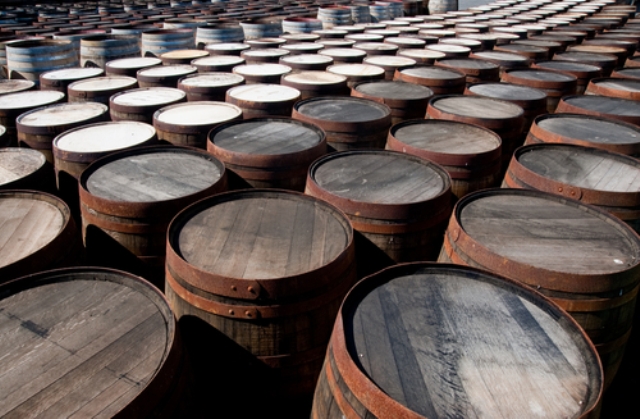
According to this article from the Chicagoist, GI is using the unlimited resources of its master to expand their barrel program. What does that mean? It means that there will be enough Bourbon County Stout for year-round production.
Let that sink in for a moment.
One of the world’s best, most sought-after, and rarest beers is going to be a year-round release. There will simply be more of one of our favorite beers available at any time of the year. That’s a good thing, worry warts.
This reminds me of labels like Sub Pop and Matador signing big deals with major labels. These indies, realizing the limitations of their distribution and recording resources, signed away something like 49% of their companies to corporate interests in order to get some cash flowing. They then used this influx of capital to promote previously-unknown bands and to give them a boost in touring expenses and recording studios. The result is that they extended their reach and prolonged their lives as productive labels. The bands have benefited as well.
As mentioned above, Goose Island selling out signaled the end of craft breweries for some. However, if GI plays their cards right, it could mean more growth for them and continued struggles for corporate beer makers as their own flagship brands suffer in the wake of quality, craft beer.
So, is Goose Island beer’s Sub Pop or Matador?
Indie-Craft Interview #1: Stillwater’s Brian Strumke
This blog focuses on the intersection of indie rock, craft beer, and other independent and/or artisinal industries. I’ve tried to raise awareness of indie and craft industries while defining what constitutes “indie” and “craft” as best I can. The idea of indie-craft has been bouncing around in my skull for a while. However, it’s been tough for me to pinpoint what I want to say about it. With the indie-craft interview series, I’d like to get the perspective of those who actually produce all these great consumables and share those thoughts here.
Brian Strumke is the gypsie brewer who produces the delectable Stillwater Artisanal Ales in his hometown of Baltimore as well as in various breweries around Europe. His take on the Saison has been a real kick to the craft beer scene, challenging convention while creating a great deal of success for himself. It’s been a quick rise to the top of the craft beer universe for Stillwater as Brian has reached the top of many lists, is in the process of establishing his own pub, and even getting his own distribution truck wrap.
After running into Brian on a couple of occasions, I figured that I could bug him to be my first indie-craft interviewee. Luckily, he agreed. The results are below…
1. Describe your craft(s).
Artistic interpretations in the form of beer.
2. What’s the importance or benefit of remaining indie?
Freedom is paramount, I am very adamant on doing things my way especially because my art is an expression of myself and maintaining the control of my art is what is most important to me.
3. How does your craft contribute to society?
Working with beer is about sharing good times with people. I produce a product that is designed for enjoyment and also use that product to make people question what beer actually is… Nothing we do is straight forward and I enjoy creating intrigue within my consumer base.
4. What other indie-craft products inspire you?
Anything that is backed by a good philosophy and executed well.
5. What is your dream of success?
Happiness.
If you would like to try some Stillwater Artisinal Ales, move to one of these places or petition your local distributor to bring Stillwater to your neck of the woods. If you want to see what I’ve had to say about Brian’s beers in the past, go here.
Be on the lookout for more Indie-Craft interviews. I have chocolate makers, filmmakers, music makers, and possibly more beer makers lined up (or potentially lined up) for future interviews. If you have a suggestion for someone I should badger with the five questions above, let me know.
Bands Making Beer
I set this post by Beervana‘s Jeff Allworth aside to respond at a certain point but (almost) forgot. It seems that there is a company out there trying “to provide concertgoers with unique craft beers” designed by the bands performing at their venue. The company allows the bands to try some beer and notes what they like. The band is then invited out to a brewery so as to better understand the process. From all this, a beer specially-designed by the band is served at their shows.
It’s an excellent idea that appeals to me for obvious reasons[1]. I could go on all day about what styles various bands might choose to brew[2]. Dinosaur Jr. would brew a dank DIPA measuring over 100 IBU’s. Tune-Yards might choose a Saison with loads of Brettanomyces. Guided By Voices…well, you know.
Then, I read the following comment at the end of the Beervana post…
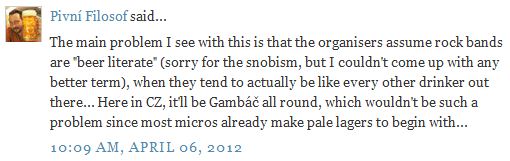
First of all, I don’t mean to call out Pivni[3]. I partly agree with him. It’s not ideal to have non-beer folk design a beer. However, who’s to say these bands aren’t equipped with taste buds? Offer them an array of interesting beers and they’re sure to pick something that’s flavorful and complex. The problem only arises when the beers you let them try or pick from aren’t much better than whatever they normally drink (assuming they drink swill)[4].
Interestingly, Jeff imagines some of Portland’s indie elite (and there are many) choosing their own favorite styles. One would have to agree that a Portlander would choose some great styles as the average beer IQ in Portland is certainly higher among all residents, even among the musician types. Where Pivni points to musicians’ beer ignorance leading to somewhat uninspired beers, Jeff sees musicians in a beer-friendly culture designing beers we beer enthusiasts would actually like.
Of course, this is not the audience for which these beers are intended. No, they’re for live music fans. Have you been to many rock shows in your lifetime? I’ll just say that most rock show attendees are not sipping a Westvleteren 12 from a chalice. They’re drinking a PBR or Hi-Life[5].
Regardless. It’s an interesting idea to serve beer designed by a band at their shows. I applaud the inventiveness, even if the there are holes in the logic. I’d really like to see this idea practiced in a place like Portland. Maybe Portland bands could tour with their beer to serve at shows[6]. That I’d like to see.
Notes:
1 If it takes off, one of two things is certain to happen. This blog will be seen as a touchstone in music and beer integration. That or I will open a venue/brewery that does this very thing. Since I have no money to start the latter, I’ll assume the former will happen any day now.
2 OR what I as a beer geek would hope they would brew.
3 Honestly, I have no problem with him. He actually writes a fairly interesting blog. I just wish Google Translator did a better job of translating.
4 I don’t know this to be the case. What I do know is that the brewery is located in the UK and I find most British beers to be not much more inspiring than most rice-adjunct, industrial lagers. That’s just my opinion and there are people way more qualified in beer knowledge that would dispute this assessment. For argument’s sake, let’s say a band really likes the tried and true ESB. So what if they help design another ESB that just tastes like all the other ESB’s out there? Put their taste buds to the test and force these bands to design something insanely original. I mean, they are creative people.
5 Thankfully, most of the venues around here have added some quality craft beers to their taps. I’ve had a lot of Lagunitas IPA over the last couple of years.
6 Of course, with state beer laws the way they are, this could never work. A boy can dream, can’t he?
How Beer Saved the World [Infographic]
I have things to say about this, but you all should comment and do the thinking for me…

Is it possible to fully appreciate something in 35 seconds?
Daniel McCord (AKA The Dude[1]), owner of It’s a Fucking Beer! , does reviews like the one you see above. Basically, he shotguns a beer, but not just any beer. No, Daniel shotguns a fine craft beer, usually consumed over a long session, poured in the proper glass.
Some would call this “blasphemy.” How is he able to fully appreciate the subtle nuances of a finely crafted beer[2]? Does he even take time to smell the beer? Does he study the appearance or note the lacing? Is he really just promoting binge drinking[3]?
Personally, I think it’s great[4]. I’ve read Daniel’s blog enough to know that he gets craft beer. He has a different way to express that appreciation, but he gets it. So, I’m not worried that he’s somehow missing out. Even if he were, I don’t care how he drinks his beer. It seems to work for him.
What he’s doing is really throwing a giant bird in the faces of the craft beer elite[5]. It’s the punkest thing I’ve seen in craft beer[6] and I hope his liver continues to hold up as he makes his way through the influx of craft cans to hit the market in recent years[7]. Daniel is bridging the gap between those who just want to blow some steam on the weekends (or possibly week nights) and those who appreciate craft beer[8].
Still, the question remains whether or not it’s possible to properly appreciate a beer when consumed in this fashion. First, who’s to say there is only way to drink a beer? It seems that Daniel’s method is the most efficient I’ve seen and it’s greener than dirtying a glass or even drinking from a bottle[9].
From Daniel’s reaction, you can tell that he fully appreciates the nuances of the beer[10]. It’s not the most eloquent review of a beer (even by IaFB! standards), but you know that it’s a hop bomb with a solid malt backbone. What else do you really need to before trying the beer yourself?
I liken these shotgun beer reviews to basing an opinion on a band or album within 30 seconds of a first listen. I usually know right away whether I’ll like a record or band. It’s not that I have a keen sense or magical powers. It’s just that I’ve heard enough music over the years to know whether or not I’ll like something. Is it foolproof? No. Sometimes, I find out that I enjoy the band immensely after further inspection or vice versa. Still, a momentary impression is an impression. There’s validity to an opinion formed in seconds. Should it be placed above more thoughtful responses? Probably not, but that doesn’t change whether or not shotgunning a beer is an adequate way to judge a beer[11].
Notes:
1 
2 I don’t know that any one person is uniquely qualified to do this. Yes, some have been trained to recognize certain characteristics of beer, but that doesn’t mean that they’re more qualified to appreciate a beer.
3 Maybe, but why binge on high-end beers? He at least comments on the flavor of the beer, evaluating it in a way no frat boy would ever dare.
4 Will I shotgun a beer? Unlikely, but I’m glad someone is doing it.
5 I don’t know who that is, but I’m sure I can find them in my Google Reader if I looked hard enough. I’m not anti-elite, just anti-elitist.
6 And that includes BrewDog. I like BrewDog for the most part, but they do some things that make me cringe. For one, they claim to be punk. Well, as Dave Berman once proclaimed, “Punk rock died when the first kid said, “Punk’s not dead! Punk’s not dead!”” You can’t call yourself punk. You really can’t call yourself punk when there are hundreds of other breweries doing the same thing, often better. If BrewDog were American, they wouldn’t even register. Now, I like their beers, but it’s not that unique in the context of American craft beer, certainly not punk.
7 I’m in favor of all the new craft cans out there. However, this is not an excuse not to pour your beer into the proper glass. I know that I support Daniel in his shotgun reviews, but I still prefer a beer in a glass.
8 In other words, he’s taking back craft and artisinal beer from the bourgeois and giving it back to the working class.
9 Again, I prefer drinking from a glass. As I often ask those who turn down my offer to pour their beer into a glass, you wouldn’t smell a rose through a straw, would you? For the purposes of these reviews, shotgunning is a fine method. However, I’ll drink my beer from a glass, probably a tulip.
10 At first, I thought the booze had gone straight to his head, but his somewhat detailed explanation demonstrated that he enjoyed the full blast of hops which certainly obliterated his taste buds for the evening.
11 I recognize that I’ve waffled a bit between my own beer snobbishness and Daniel’s middle finger to the bourgeois beer connoisseur, but what I’m getting at is that there’s room for both in craft beer. Comment freely below.
More Proof that Indie Rock and Craft Beer Belong Together
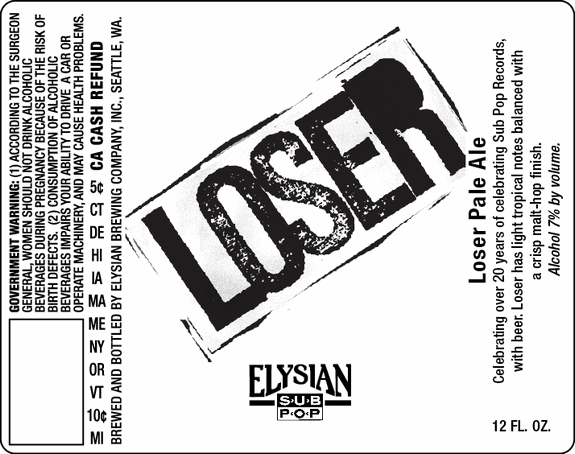
I have a bottle of this from a few years back. Someone gave it to me and said not to drink it. The bottle was old and he didn’t like it. So, I kept it for sentimental reasons. I’ll post a picture one of these days. In the meantime, know that Sub Pop is the indie label that featured Nirvana and you know what effect they had on music.
Accept this post as yet more proof that my incessant writing about craft beer and indie rock is not for nothing. Connections exist, people. Recognize. [Link]
On Sentimentality
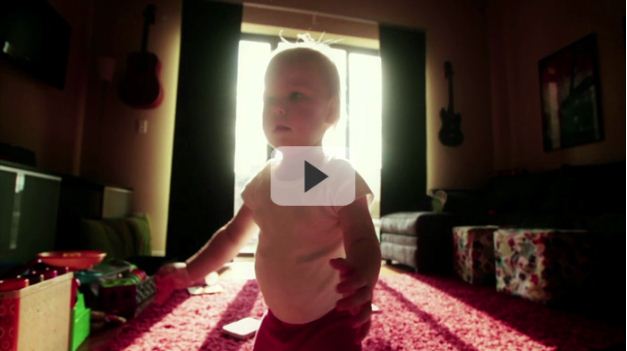
Music and images elicit a certain amount of sentimentality in its audience. In fact, producers of such art depend on that sentimentality to sell their art. It’s not a deceptive practice. Musicians have to sell records to make a living and continue doing what they love.
There’s also a more authentic aspect for manufacturing some sentimentality. Artists want to make a connection through common sentiments. If I reflect on my childhood or my child’s in a song or video and it connects with you, we create a community of sorts through this kinship. Yes, there’s profit to be made, but the human connections solidified are what’s really valuable.
Some roll their eyes at sentimentality, especially when something’s for sale. Take that Deschutes video I shared a while back…
Some beer enthusiasts were upset. They felt duped. Someone was accessing their sentimentality to sell some beer. They don’t like that and feel craft beer should be above such nonsense. However, it’s naive to think this way. Man, everything’s for sale, including your sentimentality. If you’re aware of it, who cares? Why not enjoy the moment?
I get a certain bit of sentimentality from beer and music. I’m okay with it being used to sell me more beer and records because I’m aware of what’s going on. I can separate something that makes me feel sentimental from what you’re selling. However, if I too feel sentimental about your product, I’m more than willing to shed reason to satisfy that need for sentiment.
Take the video at the top of this post for example. I have all kinds of feelings for this one piece. First, the song is by Eric Bachman of Archers of Loaf fame and now Crooked Fingers. Archers of Loaf captured the angst and blue-collar anger of my youth, feelings that still resonate with me. Crooked Fingers came around at some interesting transitions in my life. Darker sides of my mindset heard Bachman’s drunken laments and it connected. Ever since, the more mature material Bachman has released speaks to me as I grow older and accumulate adult responsibilities. His last album was completely overlooked by me and possibly should have made my final ten of 2011. For this, I feel a little guilty.
The video and song together really connects to sentimentality of my current state. Watching a young girl grow, discover her family history, and suddenly realize she’s grown really makes me think about my own daughter. Additionally, friends have recently asked me what fatherhood is like. for three years for her life, I’ve almost never had to answer this question. However, it’s come up a lot lately. I’ve surprised myself with how much I’ve had to say about it.
 This leads to a moment I had today. My mom called me this morning to tell me that my grandfather died earlier in the day, the day between my wife’s birthday (yesterday) and mine (tomorrow). She told me how she was able to see him before he passed. He wanted to talk, but the oxygen mask he was wearing wouldn’t permit his words to heard. She said by the time my aunt arrived later in the evening, he was virtually in a coma.
I thought about that moment, the moment my grandfather’s daughters had to see him in the most vulnerable of states. I thought about the last moments he had to look into his daughter’s eyes. I imagined the moment I will have to do the same.
This caused me to shutter a bit, but it resonated. Yep. I got all of that from one little music video.
I write about my interests because I feel connections to people through these things. I remember sharing a Goose Island Christmas ale with my grandfather the last time we celebrated the holiday together. My sister played some Bettie Serveert on Facebook today to help her cope with the sadness. I’ve listened to nothing but Bettie Serveert all day, remembering the summer I spent in Seattle when I caught them live.
Beer and music are there throughout our lives when the good and bad happen. Sure, there are other things, but these are the things to which I connect. So, I feel as though we should insure that these moments are connected to the best in both. I want the most meaningful music and the highest quality beer to connect to the times I share with loved ones.
Does this make me more susceptible to advertisers playing the sentimentality card? Sure, but why not enjoy feeling that connection now and and again? Honestly, I’d rather play a record for sentimental reasons than because Pitchfork told me to. I’d rather remember the time I had a heart-to-heart with a friend over a good craft beer than fully sober and without a taste in my mouth that will take me back to that one moment in time…
Now ‘m rambling a bit. Appeal to my sentimentality. I’m cool with it. I like feeling and remembering, things humans do.
By Definition
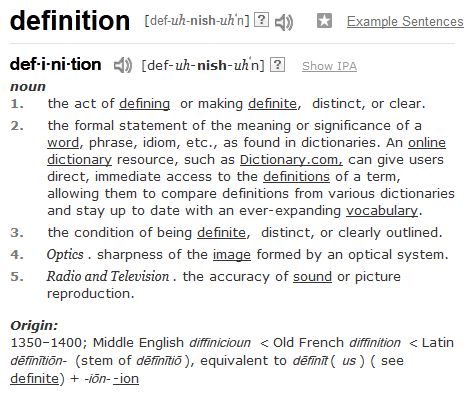
Folks are really hung up on definitions. Some definitions seem vague and disconnected. Others change depending on the context. Still, certain definitions are there just to create controversy. Whatever the definition, whether it be beer or music, they make for excellent fodder for a blogger in need of a topic to post.
The “session beer” is a highly controversial term. Beer Advocate has their somewhat Americanized version of what most Brits consider to be session beer. Then, there’s the session beer gospel as preached by Lew Bryson at his Session Beer Project. I’m not going to go into the definition of the session beer except to say that whatever you’re drinking over an extended period of time that doesn’t completely drop you beneath the table is close enough to a session beer for me. I’ll let others debate ABV criteria as I rarely choose a beer solely on alcohol level. (Although, I have avoided certain beers that would have rendered me unable to drive home.)
There’s been some talk and disagreement over the origins and definitions of the West Coast IPA. Jeff at Beervana attempted to solicit the help from his readers in order to align his own definition with the masses. This sort of topic borders on debates over terroir and a vain attempt to identify one’s region with a beer style. It’s really no different with the controversy over Cascadian Dark Ales and/or Black IPA’s. Brewers/marketers are trying to tie a beer’s definition with their particular region. Sure, styles originate from and often taste different when brewed in different locales. However, the makeup of the beers are generally similar. I enjoy how an IPA from Michigan tastes as much as I enjoy how one from San Diego tastes. Locale is a factor, but I won’t define a beer style solely based on region. It feels limiting and lazy.
Lately, a couple of definitions have come under fire. It seems there is a crisis over what constitutes craft beer in the UK. I’m not familiar with Simon Johnson’s Reluctant Scooper, but in his post titled “The Craft Beer Manifesto“, he takes a jab at what defines craft beer (in the UK, at least):
1: Only use distilled otter’s tears
2: Use only barley that’s been warmed by the breath of kindly owls
3: Craft beer cares, so only use hops that have been flown halfway around the world
4: You can have it any colour you like, as long as it’s not brown. Unless its an Indian Brown Ale
5: Beards allowed only if they’re ironic
6: It’s not “inconsistent”, it’s “experimental”
7: It’s not “hiding faults”, it’s “barrel-ageing”
…
I found his list (all twelve) to be pretty funny. However, scrolling through the comments alerted me to some curmudgeon-like attitudes toward beer. I don’t know how everyone defines craft beer, but it seems to me that it’s beer brewed using traditional methods on a relatively small scale. The definition that Johnson hints at – with tongue firmly planted in cheek – is what has been marketed to us in one way or another. Some has been by design as breweries fight for their own unique place in the industry. Some is a creation of the craft beer geek culture where bigger, extreme-er beer is appreciated most. I think it’s a simple thing really, determined by brewing methods and production. Still, the manifesto is a funny list to discuss at the bar. (H/T Stan)
Another blog post has pondered the definition of a brewer. Zak Avery ponders the question perfectly and the proof lies in the responses he generates from his readers. The definitions are all over the place as each commenter has his/her own perspective on what constitutes a brewer. Simply, I’d suggest that a brewer is anyone who brews beer. There are good and bad brewers, ignorant and knowledgeable brewers. If we want to get technical, we could divide brewers between home and commercial, but sometimes there isn’t much difference in this dichotomy. The debate could go on, but that’s why it’s such a great question or rumination. (also H/T Stan)
Commenter Bill Farr asked me to define indie rock. Has anyone really tried to do this? Actually, some have. AllMusic of course has something to say:
Indie rock takes its name from “independent,” which describes both the do-it-yourself attitudes of its bands and the small, lower-budget nature of the labels that release the music. The biggest indie labels might strike distribution deals with major corporate labels, but their decision-making processes remain autonomous.
On the surface, that seems easy enough. However, when bands sign with major labels, whether or not they really do make “autonomous” decisions is up for debate. Too often, the idea of indie rock has been assigned to a certain aesthetic. Honestly, I am guilty of limiting this segment of music to the music I like: guitar-centric, rock music preferred by white males who attended college in the mid-90’s. I realize that I’m ignoring a huge amount of music when I proclaim indie rock as my favorite genre of music. Really, what I should do is say that I appreciate indie rock, but I prefer bands like Pavement, Guided By Voice, Sonic Youth, The Walkmen, etc. Luckily, it’s not up to me to define indie rock for you. We have AllMusic and Wikipedia for such trivialities.
Where definitions get interesting in indie rock is where we actually start to define genres and sub-genres. Lo-fi was made popular as an aesthetic where bands recorded in bedrooms on cheap four/eight-track recorders. Riot grrrl defined a generation of punks hellbent on injecting the DIY, punk scene with some estrogen. Baroque pop was the only monicker someone at Spin or Rolling Stone could muster in order to explain what Arcade Fire or Beirut were doing. I could go on and on with genres and subgenres made popular in indie rock circles. The topic of these genres is enough to write a book on its own.
So, what am I getting at?
It seems a great deal of time is spent on blogs and books and whatever media one prefers trying to define everything. The only problem I have with this is that so many of us (myself included) spend a lot of time trying to define it for others. No longer do we listen to (or read) each other and try to meet at an understanding. I’m as guilty of this as anyone. A certain amount of anonymity and/or distance provided by the interwebs does that. I’m trying to get better at this and simply state that what I post here is just my perspective. Sometimes that’s clear. Sometimes it’s not.
I prefer to see these definitions as evolving tools to better understand one another. If you and I have different ideas as to what a session beer is, it might make for a more enjoyable session if we know from where each person is coming. Let’s say that I am a Lew Bryson disciple and will only drink session beers measuring in at 4.5% or less and you’re the type that can’t taste anything below 9% ABV. It would be helpful to know that I can throw back several pints over the course of evening while you may want to limit yourself to sipping one or two beers over the same time period. Without this understanding, one of us comes off looking like a drunk: you for drinking high gravity beers at the same pace as I or me for throwing back five pints in one sitting.
When I talk music with people, the definition discussion is much easier. No one is stuck to one definition for a band or an album. We prefer to delve into what the music is doing for us and what influences it resembles. Conversely, the beer nerd conversation is dependent on the definition of a beer or its style. Thankfully, this grip on definitions is loosening as some in my beer circle would rather talk about tangibles of the moment or how the beer tastes in that particular context. To me, these discussions over definitions are so much more useful and productive rather than one party insisting on whatever is etched in stone while another pontificates that all formal definitions are obsolete.
Thankfully, Martyn Cornell provided some reason to the conversation and yet another term to help describe what we beer enthusiasts like. He used the post to promote the idea of “fine beer”, you know, like “fine wine” or “fine dining”. I’m all for it, but I won’t use this space to go into that. His main point is the same point I’m trying to make. Basically, the labels we use to describe what we like (craft beer, indie rock) are just the words that make it simpler to tell outsiders or newcomers what we like. It’s a way to organize store shelves and record bins. It doesn’t adequately describe all the reasons we like what we like. It’s shorthand. It’s easy, almost lazy. (Martyn didn’t say this exactly. I’m sort of paraphrasing.) So, the energy spent defining lazy terminology is energy wasted.
I will continue to use the terms “craft beer” and “indie rock” to describe my tastes in drink and music. I will probably also try to define these interests with each blog post. However, I am not trying to define these specific terms for you. What I am attempting to do is to define what I like and why. I am trying to make the case – like many have done before me – as to why this is important. I am not attempting to define beer and music for you. I am just trying to engage the conversation, the thing that goes neglected when we have to define everything.


 Beer and Pavement
4 comments