Kickstart Swearing at Motorists
I have never supported a Kickstarter project that didn’t achieve full funding and I’m not going to let that change. Swearing at Motorists recently announced that they would be releasing their first album in 6 or 7 years. To do this, they (read: “Dave Doughman”) opted to fund a new record on Kickstarter, which brings us to the purpose of this post: SUPPORT SWEARING AT MOTORISTS’ KICKSTARTER CAMPAIGN!!!
To promote the campaign, I’m including a link to the Kickstarter, video of one of the record’s tracks, some reposted content on the band, and a Spotify playlist. Do the right thing.
Swearing At Motorists – Groundhog Day (Damn The Piper) *OFFICIAL MUSIC VIDEO* from mike postalakis on Vimeo.
Swearing at Motorists – Postcards from a Drinking Town
And that drinking town is Dayton.
 Swearing at Motorists rose from the ashes of Dayton, Ohio to produce a sound that was so Ohio, you’d instantly shit buckeyes[1] upon hearing one of their records or seeing the two piece live. I’ve written before about the band. I once told a story about the band while getting all the details wrong. Frontman[2] Dave Doughman set me straight. Sadly, I thought there would never be an opportunity to do so again as the band called it quits a couple of years back. That is, until they released a download-only collection this week of old singles and rarities called Postcards from a Drinking Town.
Before I get to Postcards…, let me tell you a little bit about Swearing at Motorists. The band was nicknamed “The Two Man Who” and that moniker fit, but it was only half the story. On record, the sound was particularly lo-fi, but like the other Who-like Dayton band Guided By Voices, SaM songs were bigger than bedroom recordings. Live, the band was like an uppercut to the jaw. Sparse instrumentation filled space between Doughman’s tales of breakups, boredom, and too much beer. Swearing at Motorists were so engaging that it was hard not to be drawn into Doughman’s never-ending sagas. If you missed Swearing at Motorists, you missed out on something pretty great[3].
That said, I was pleasantly surprised Tuesday afternoon when across my Facebook feed came the following post…
This had been on my radar, but I had forgotten all about it. I immediately followed the link and downloaded this fine collection of 7″ and compilation tracks not found on the band’s seven or so proper releases. These tracks are a fine artifact of life in western Ohio in the mid-nineties. I felt everything was lo-fi back in those days[4]. We made what we had work. We were DIY by necessity. A band like Swearing at Motorists could capture that time. Thrift store t-shirts, souvenir ashtrays, shitty tape recordings…Those were the days.
While I recognize that my bias toward anything SaM releases, I also think there’s something here to which you could relate, dear reader. You’ve been drunk once, right? You’ve been dumped and out of work. You’ve surely seen a bar band or two. Somehow, I think you could relate to Doughman’s everyman persona. And that’s all it takes to love a Swearing at Motorist release. This one, in particular, is more raw and authentic than most. These recordings define lo-fi, but the genius behind the songs is unmistakeable.
If you haven’t done so already, head over to Secretly Canadian and download your copy of Postcards from a Drinking Town. And while you’re at it, go here and download the free two-song EP To Gem City with Love. Of course, that’s only the beginning as you’ll surely want to explore more of Swearing at Motorists’ catalog.
Update: It seems, judging by all the activity from Doughman online, that Swearing at Motorists did not call it quits after all. There are reports of new material out there as well as some hints of a tour. This is good news for sure.
Notes:
1Or horse chestnuts. Whatever you want to call them. Either way, they’re a poisonous nut.
2I use this term lightly as Dave Doughman is really all of Swearing at Motorists. It’s typically him and a guy on drums. I checked the Wikipedia page just to see how many dudes have played drums for Doughman. It looks as if three different guys have played drums. While on Wikipedia, I also found this nice little tidbit…
Doughman mixes trace amounts of his own blood into the ink used in the disc printing process, pioneering the concept of the GrisD. Rumors persist that there was confusion over the term “serious chops” in his contract with Ol’ Scratch, and after some antics over semantics, can now grow sideburns to equal any cartoon samurai at will. Doughman’s documented penchant for sleeping in a topknot may be the source of such speak.
3This is why it’s so great that these tracks were reissued. That and something was said on a Facebook thread about playing in Oregon. Could there be a tour in the works?
4Seriously, our soundtrack was one shitty tape after another. Everything seemed muffled by tape hiss.
 I was recently on a long drive from a workshop when I found myself with no new music in the car of which to listen. After searching through piles of CD’s, I stumbled upon a mix of songs by Swearing at Motorists. There were 35 songs on just one CD to be exact, and they filled my need for intensely exposed yet personal indie rock that invites you to sing along while traveling down long stretches of I-70. (I don’t know if this is a genre yet, but it should be.)
I began to sort out in my mind just what made SaM so important to me. Was it that they originated in Dayton before moving to Philly before moving to Berlin? Was it the great name? Was it their beautifully erratic live act? Was it the sudden impact of guitar chords followed by pain and silence only to repeat? Was it that they had opened for U2 in Europe but could barely fill a dive in their hometown? Was it the “average Joe” lyrics of hard times and even harder relationships? As I thought about the reasons why I love this band, I rocked out all the way back to COMO.
Dave Doughman is the primary player in SaM. His lyrics hit hard and mean something to anyone who has ever grown up in Ohio, has probably had too much to drink, and hasn’t always had the best of luck with life in general. His sharp-witted lyrics, deep-throated delivery, and sparse instrumentation make up the SaM sound. Like the White Stripes (whom he’s literally challenged in rocking out), SaM sound primarily involves voice, guitar, and drums. However, unlike his more successful counterparts from up north, the songs often are filled with space, and each instrument takes its turn to make a point.
 I remember seeing Doughman for the first time at tOSU’s Springfest. His set was the highlight of the day. A friend-of-a-friend talked me into staying around to check their set. He had the experience of a lifetime being a roady for the band at South By Southwest and convinced me that they were worth the wait. They were. (It should be noted that the headliner of that show was the White Stripes, way before they hit big.)
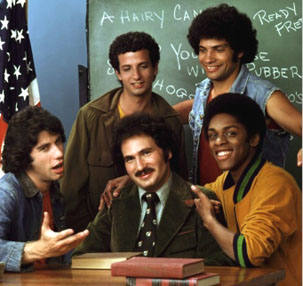
Doughman came out in a blue corduroy FFA jacket, Welcome Back Kotter mustache, and a bushy ‘fro. In addition to his non-hipster appearance, he spoke so fast and incoherently that you giggled at the sights and sounds before you. His speak consisted of the type of “here-ye, here-ye’s” you’d hear at the circus or from an old-timey traveling medicine man. He was manically selling his band, and then he played. What came out was this deep, suffering wail between aggressive guitar licks and a slow drum beat. The man sold his pain, and I was buying.
My brother told me a story of a Dayton show that only confirmed my feelings of pure delight and intrigue felt that day. Many of Doughman’s songs are about his continuous relationship problems. Apparently, one of those break-ups was rather public in the Dayton scene and eventually carried out at a SaM show.
The Dayton set began as a rival for a certain love interest of Doughman’s walked through the door. Doughman suddenly stopped in mid-song yelling for the guy to turn around and leave (in so many expletive-filled phrases). He then took off his guitar and leaped through the crowd to chase the guy down. After a few punches were thrown and mamas insulted, the guy was given his money back and left, and Doughman returned to the stage to continue his show.
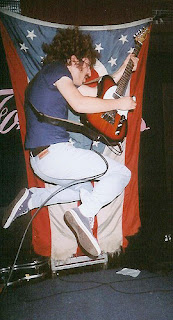 The impulsiveness of Doughman’s actions in the Dayton story best illustrates his general demeanor on-stage and the feel one gets while listening to his songs. You sit back to relax and enjoy some heart-on-the-sleeve poetry with the occasional humorous quip when he abruptly throws you from your chair with a cry for help and intense strike to his guitar strings.
The music is a slower, more mature version of emo. It’s on the blue-collar side of lo-fi and the road-weary side of indie. Conversely, Doughman and co. are considerably more exposed and artistic than the most working-class of the bipster set.
I love this music for its realness. Doughman knows best how to capture the pain of relationships, failure, and the resulting depression. In addition, he can contextualize his message into something that resembles growing up in western Ohio. Oh, and he puts on a great live show.
Buy Swearing at Motorists now!
Photo of Doughman flying stolen from pandora 1251.
Tempering Expectations
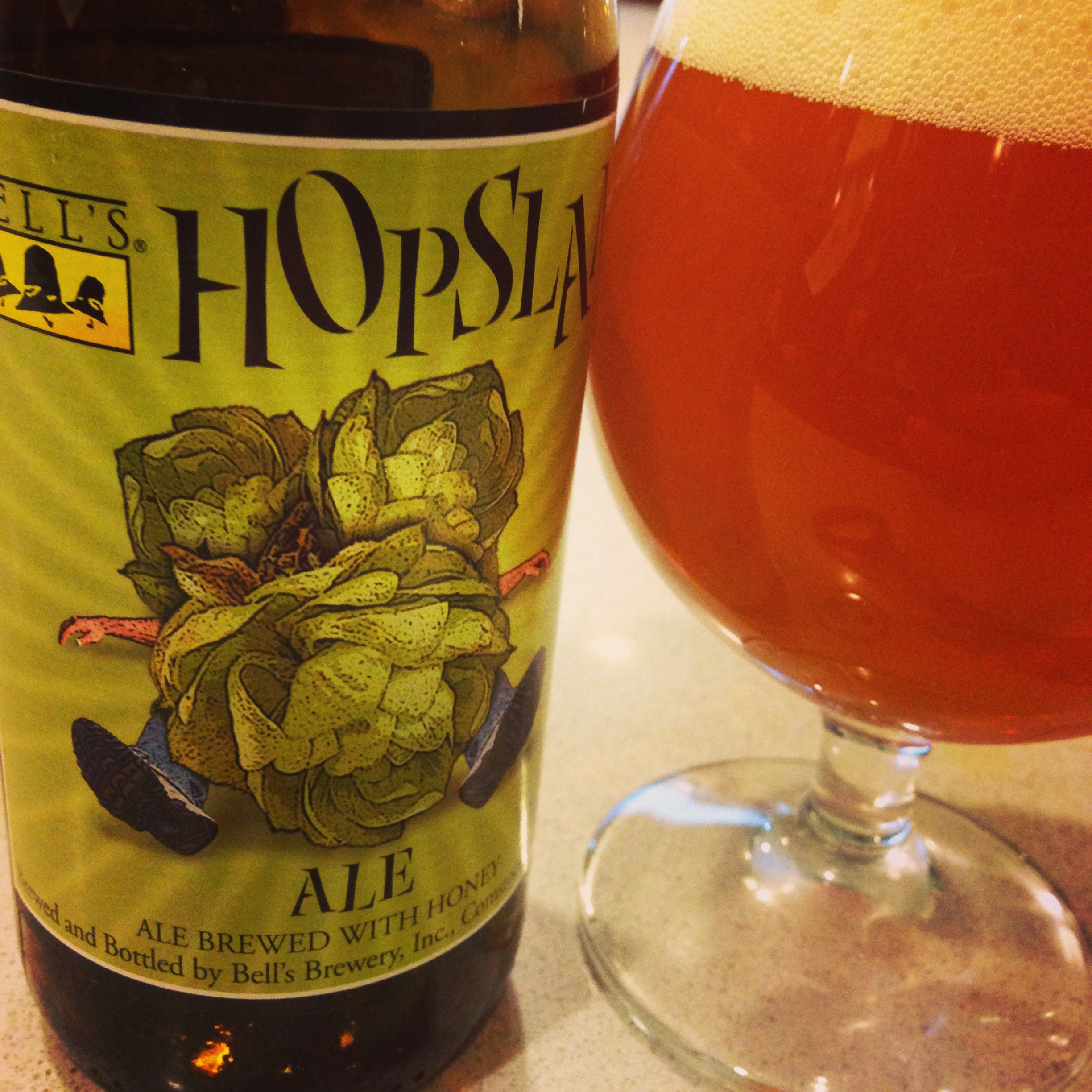
Hopslam arrived here in frigid Middle Missouri and it brought along with it loads of hype and hops. My love for the beer has cooled but not totally gone cold. I have learned to temper my expectations, not lower them. This is a lesson learned from years of buying records and seeing rock shows. See, this blog’s original premise still works.
See, a beer like Hopslam is almost as much about hype as it is anything else. It’s released only once a year in limited quantities. It’s a beer geek’s beer, loaded with hops and booze. Those bright green labels picturing a poor bloke begin crushed by a giant hop calls craft beer consumers like voiceless sirens. (Can that even work?) The ~$20 makes you think that it’s a big deal. Oh, and it is a pretty good beer.
However, the next Hopslam doesn’t ever taste like the first one. This year’s version never tastes as good as last year’s or the one you drank seven years ago. I don’t know if it’s a problem of drinkers building it up too much in their own minds or something more akin to a heroin addiction. It’s probably a little of both. Either way, the hype and misperception leads to bitter disappointment every time.
Still, Hopslam is an excellent beer. I have come to expect a well-crafted beer that hides an incredible amount of booze while introducing my palate to some sweetness and bitterness without fail. What I don’t expect is the same burst of grapefruit or cat piss or whatever aromas the hops might unleash. It seems that big DIPA’s like this are really dependent on a large amount of hops. If one harvest or another is slightly off or just different in one way or another, the effects are magnified. The beer tastes different every year, but it is always well-brewed and worth a try.
I’m good with Hopslam these days, but that wasn’t always the case. Two or three Hopslams ago, the beer didn’t meet my expectations. I wanted that crazy honey-coated grapefruitiness that smelled of a cat lady’s house sweater I tasted just the year or two before. However, as explained above, the beer was different. On top of this disappointment, I really had to go out of my way to spend a lot of money on beer. Here in Middle Missouri, Hopslam lasts tens of minutes, not days or hours. So, if you want some, you better be prepared to stalk the local beer dealer. Then, you’ll pay $20 a sixer. I used to buy at least two, sometime more. If I had to work that hard and spend that much money on a beer, it better meet my expectations.
Hopslam didn’t meet those expectations. So, something had to change. Last year, I didn’t buy any in bottles, only on tap. The 2-3 Hopslams (plus a bottle from a friend) were more than enough. I didn’t overdo it. I don’t blow a wad of cash. It was a good beer among many. I was satisfied, but my exportations were not lowered as much as they were tempered. “Enjoy the Hopslam, not the Hypeslam” was my new mantra and it worked.
2014’s version rolled out this past week and I welcomed it. I wasn’t going to buy a sixer this year. I have a deal with my mom to grab one in Ohio where it sometimes sits on shelfs for weeks or months. Then, coworkers were running out in the middle of the day to see if the grocery nearby had some Hopslam. I joined them and scored a sixer. One’s enough.
I won’t write a beer review now. You should know that this year’s version is good. I’m glad I bought some and look forward to having more on tap or in a few weeks when my mom delivers the sixer she bought for me.
What I wanted to focus on was the idea of tempering expectations. As I mentioned above, tempering expectations is something I do. However, the ability to do such with beer has been a recent development. No, I’ve been tempering expectations for a long time in terms of what I expect to get from a new record or rock show.
I realize that it’s semantics and someone will undoubtedly argue that tempering expectations is the same as lowering them, but this is my blog post and I say it isn’t the same. Tempering expectations considers contexts and past experiences. It keeps me in the moment and more mindful of what I am experiencing. Tempering expectations doesn’t allow those expectations or preconceived ideas to taint reality. Instead, I can enjoy the experience in real time.
Take Stephen Malkmus’ new album Wig Out at Jagbags as an example. I loved, LOVED Mirror Traffic. My expectations were high for Jagbags, but I realized that this was going to be a different record and it needed its own opportunity to win me over. Of course, the album didn’t have to impress me at all. Malkmus has done enough in Pavement and with Jicks to earn my loyalty. Still, I listened with anticipation. To be honest, the first few listens didn’t impress. It took 3-4 concentrated listens for me to appreciate this record, but I did. Is it as good as Traffic? I don’t know. Does it have to be? All I know is that it’s a good record at this moment and I enjoy listening to it.
See? It’s all about tempering those expectations so that we can enjoy what’s right in front of us. Stay in the moment. This year’s Hopslam doesn’t have to be last year’s or the version bottled six years ago.
Craft Beer’s Hipster Problem
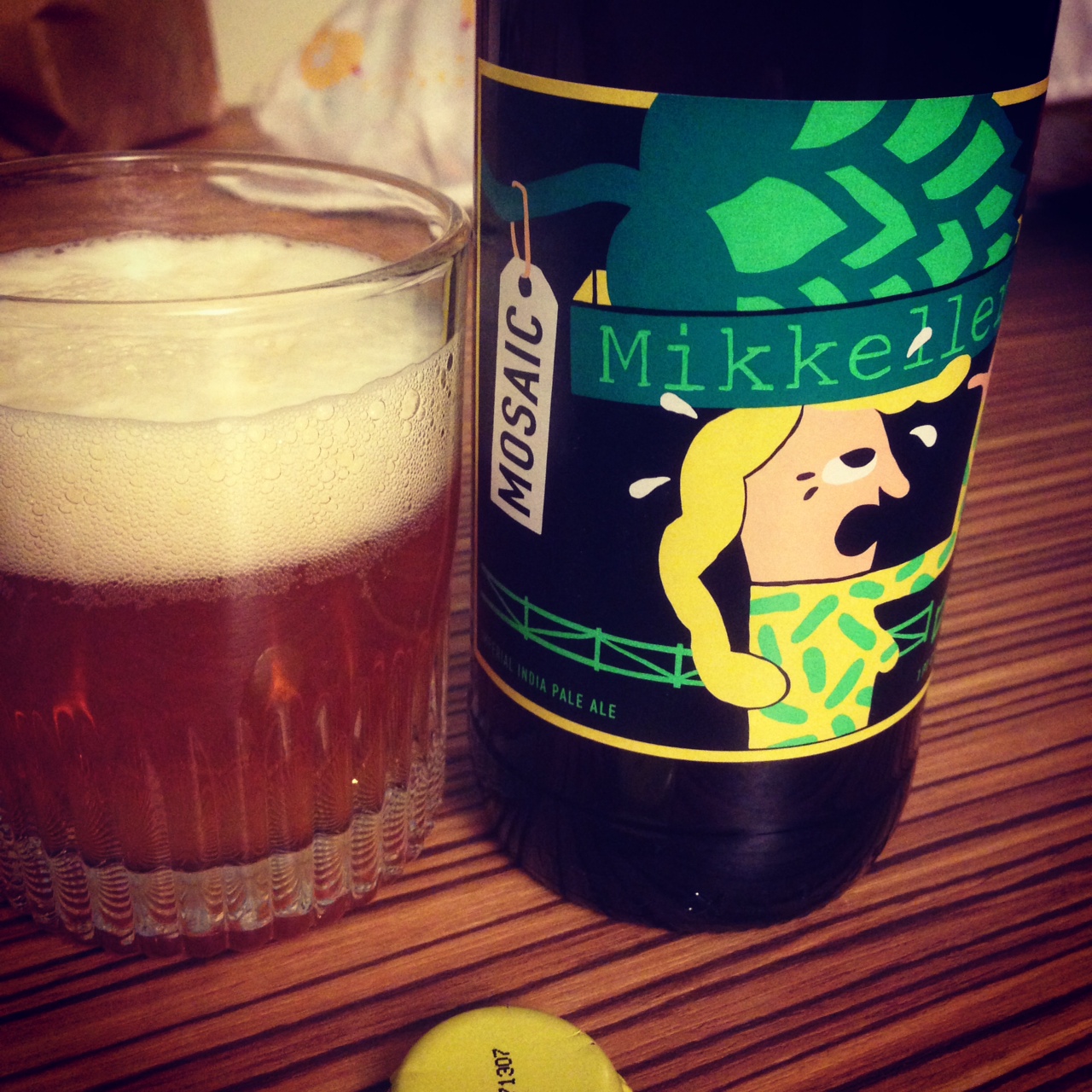
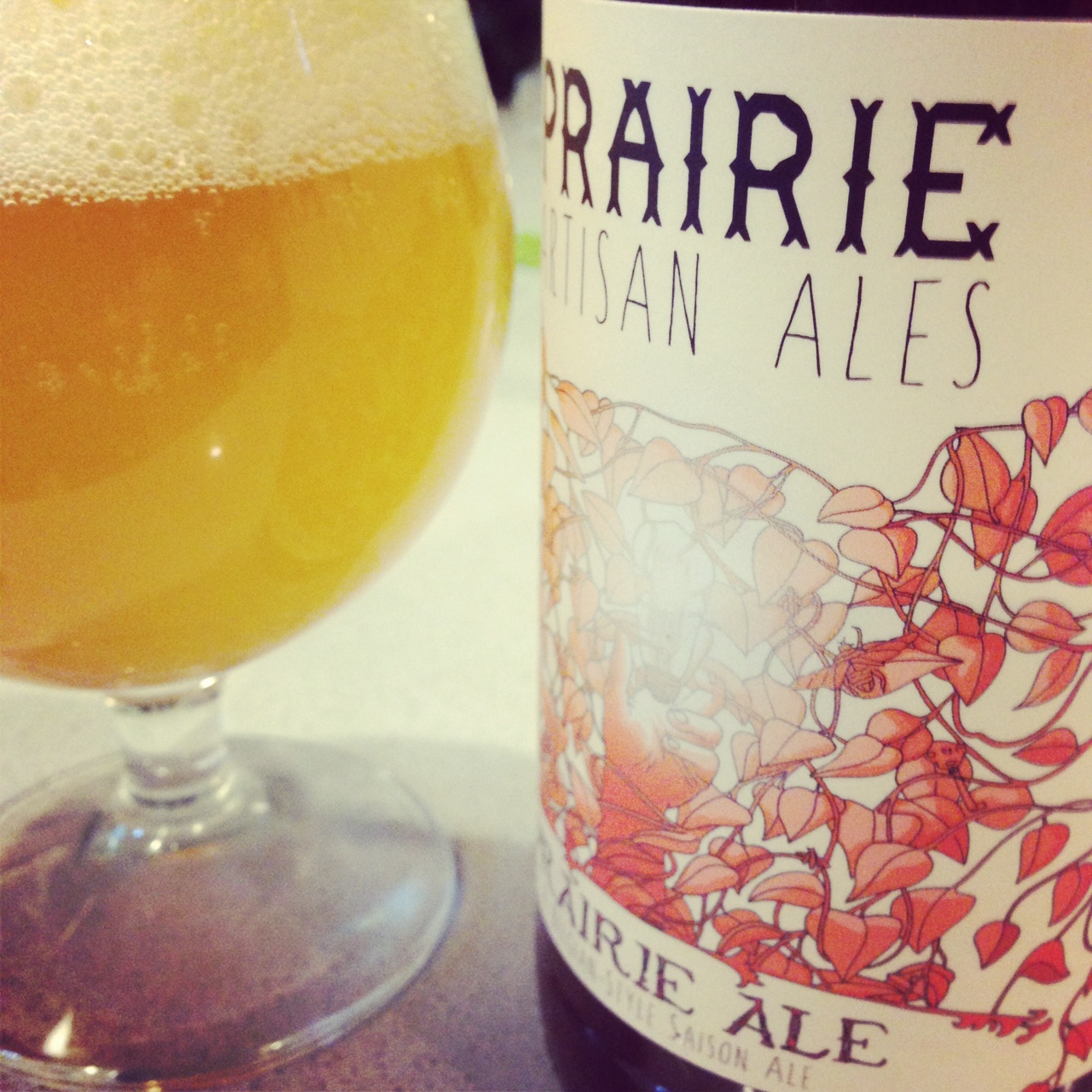
I bristled at the idea of writing yet another post about hipsters, but I felt this had to be addressed.
First, let me say that I am decidedly pro-hipster at best or ambivalent toward them at worst. It’s a label placed on certain stereotypes that I don’t feel like getting into at this point. All you should know is that being a hipster is relative and that we’re all hipsters compared to someone.
When I say that craft beer has a “hipster problem”, what I am referring to is a perception of pretentiousness. Hipsters – right or wrong – are seen as pretentious. Whether it’s fashion, music, transportation, decor, or food, “hipster” is considered equivalent to “pretentious douchebag.” So, maybe it’s hipsters with the problem, but I digress.
Craft beer is neither exclusive to hipsters nor pretentious. However, as they say, perception is reality. And the perception is that craft beer is exclusive and loved by snobs. Exclusivity these days is blamed on hipsters for whatever reason.
The actual reality is that craft beer is decidedly not a hipster thing. The movement has been around for a while. The people I connect with craft beer are not very hipster-like. Just within my social circles, craft beer enthusiasts aren’t exactly the hippest lot. This is not a putdown. It’s just a reality. They are mainly white men aged 30-50. Yes, some of them own an Arcade Fire CD. Yes, some will wear ironic t-shirts. However, these are fairly benign practices these days. Ten years ago, they totally would have been hipsters. In 2014, not so much.
Now, a lot of hipsters are getting into craft beer. It’s artisinal. It’s really popular right now. It’s beard friendly. There’s a lot in the craft beer community for hipsters to like. However, when push comes to shove (and as the wallet empties), PBR and Hi-Life aren’t that bad.
Seriously. Craft beer is attractive to the North American Hipster because craft beer tastes good and gets us a little tipsy. That’s basically the same reason we all love it.
The more insidious part of craft beer’s perception problem is the pretentiousness with which the community has been unfairly labeled. Yes, it’s expensive. Yes, it features exotic flavors and production techniques. Yes, it’s better than what you normally drink. Yes, they have silly names. However, a preference for the finer things does not necessarily mean that one is pretentious.
If anything, craft beer enthusiasts and brewers are some of the least pretentious people I know. They willingly share. They participate in online forums such as this one. They share. They fucking drink beer with you. And they share.
I don’t know how craft beer can fix their “hipster problem.” I suggest we all continue to buy beers for our more skeptical friends and drink an industrial, rice-adjunct lager now and again just to show our more human side. The hipster perception is not a problem. Trust me. But the perception of beer snobbery is and we must do what we can to fix it.
(Maybe I should do the same for indie rock. Right, Taylor Swift?)
On Spotify
Recently, Stephen Malkmus was interviewed by Rolling Stone, closing with the following question and answer after admitting that he doesn’t make playlists “on those evil Spotify places” for his daughters.
RS: You’re anti-Spotify, then?
SM: Definitely. I think it sucks.
I am one of those parents who has made a Spotify playlist for my kid – a mixture of songs I think she should like and songs she actually likes. I use Spotify all the time. It streams throughout my work day, at home, and sometimes on the road. I used to make a daily playlist with the help of my Facebook network and that has turned into its own co-op. And yes, I pay a monthly fee not to hear commercials and to have the service available anywhere I go.
Spotify really is ideal. I don’t have to worry about the longevity and capacity of my iPod. There’s no need to figure out a way to lug my records everywhere. I have a service available to me that pretty much will allow me to discover and peruse almost any artist or band on the planet. Spotify is a fantastic breakthrough in music and technology.
But why do I feel so guilty for using the streaming service?
Well, other than Malk’s reaction to Spotify, there are other reasons I question its ethics. As you may or may not know, I am a big proponent of craft and indie industries, indie-craft, if you will. It irks me to see large corporations like Spotify and record labels profit from the hard work of artists. At the same time, musicians get a tiny cut of what is a billion dollar pot. There are plenty of reasons not to use Spotify.
Lost is the record collecting culture that used to be a huge part of music. Even those brought up on CDs long for the days of owning something again. Although almost any album by almost any artist is available to stream, it’s never really yours or free of the Spotify interface.
There are the horror stories of artists getting fleeced by the Swedes via dinky royalty payments. Damon Krukowski of Galaxie 500 and Damon & Naomi famously broke down his paltry payments from streaming services on Pitchfork. And it can be argued that Spotify is not the friend of new and lesser known bands as compared to the payouts offered to catalogued bands and their corporate overlords.
Of course, this isn’t the whole story. Consider what the rest of Malkmus’ quote stated:
That doesn’t mean my music isn’t on there, though. I’m against a lot of things that I do in life, and I still do them, so there’s a lot of self-deception in all our lives. At least in the life of an unprincipled musician.
So, based on this statement, Spotify can be seen as a necessary evil. It’s akin to doing radio interviews or promos at best and selling songs to corporations for commercials at worst.
Of course, the real problem in all of this is the record industry as a whole. Why are we blaming a streaming tool like Spotify and not the greedy corporate leaches known as major record labels. Billy Bragg – champion of the working class – thinks as much and I tend to agree.
In his critique of the confluence of Pandora and Spotify, David Marcias takes issue and makes it clear why Spotify actually benefits musicians. Essentially, he makes my argument in favor of Spotify for me. (Yes, that’s where I’m going with all of this.)
To compare the two in terms of what they’re paying out is a completely fallacious construct. When Mr. Krukowski complains about the amount that he got paid on his BMI statement for his song, what he should be comparing it to is how much he got paid for an equivalent number of spins at terrestrial radio on that same BMI statement. My guess is that he did not get 7900 spins on terrestrial radio; one of the great gifts of Pandora and other tech-based companies like them is that they give an opportunity for music to be heard that terrestrial radio has neither the bandwidth nor interest to play. Technology has been a boon to independent musicians. I would also like to ask what his compensation from Sound Exchange was, both as an artist and what his label made from those spins. Whatever it was, it was more than what was paid out by terrestrial radio, who pays no compensation to owners of recordings. If you want to protest THAT, I’ll grab my pitchfork and meet you in the town square.
Basically, artists are getting paid per play at a better rate than what they get for radio, which is basically nothing. Additionally, Spotify (and Pandora) offer artists exposure the marketing departments at their labels, radio stations, or MTV (LULZ) combined. They’re getting paid and exposed on a tool they despise? That doesn’t make sense.
Then consider the pirating issue. While pirating music does offer a certain amount of exposure, it offers nothing monetarily for artists. Pirating sites and participants are the real enemies of musicians, not Spotify. Although I don’t totally trust the correlation, Spotify has made the argument that their service has contributed to the decrease in pirating in the Netherlands. It’s a fairly weak argument, but it isn’t out of the realm of possibility to imagine Spotify or similar services making pirating obsolete or at least unnecessary.
I use Spotify and don’t have a problem with it. I pay a monthly fee so that I have access offline and don’t have to hear ads. I make endless playlists. Still, I generally listen to whole albums. Several recent discoveries have been via the service. And even then, I still buy a lot of vinyl or go to shows when I can. If anything, Spotify has improved my financial support of many great artists.
Is Spotify evil? Maybe. It is a corporation making money off of art. That said, I’m just happy I can listen to the music I love whenever I want and wherever I want.
BTW, most of what should be read on the Spotify issue can be found here and a playlist celebrating our corporate overlords is below via Spotify, of course.
Craft Beer Craze Lesbian Bed Death
Lesbian bed death is the idea that lesbian couples tend to lose their sexual dynamic over time and just end up doing a lot of cuddling. This is how I would describe the state of my love for craft beer. What was once a fiery, passionate affair bordering on the edge of obsession has slowly devolved into lukewarm feelings toward my lover, craft beer.
Craft beer is taking up less and less of my resources – monitory, three dimensional, mental capacity, etc. It’s been forever and a day since I’ve attended a monthly tasting with my beer enthusiast club. I can’t even remember the last tap takeover or special release I attended at one of the many watering holes around town.
Like my blogging, beer became a chore. How was I going to get my hands on another special release? Weeknight tastings took a toll on showing up for work the next day. One $20 bottle after another was being released, filling my beer closet faster than I could drink the beer already within. When I wanted a beer with dinner that wouldn’t knock me out due to either size of the bottle or advanced alcohol levels (or sometimes both), there was nothing. Every beer I owned or longed for was a barrel-aged, special release topping double digits in alcohol content percentages. It was exhausting, not to mention terrible for my health.
I actually ran a marathon last spring. The strides I made physically have basically been lost. Sure, some of that is because I haven’t run as much as I should, but high gravity beers haven’t helped.
So, I fell out of love with craft beer.
However, like lesbian bed death, my deteriorating love affair with craft beer is actually a myth. I haven’t given up supporting craft breweries. I haven’t gone cold turkey by any means. I still buy and sample fancy beers whenever I can. The craft beer craze for me has just settled a bit.
What’s funny is that I have avoided talking about craft beer fatigue for fear of being ridiculed. For example, some members of my beer club’s Facebook group go over the edge when they can’t get their hands on certain releases. I’ve suggested now and again that it’s just beer and there will be other beers. To my dismay, I virtually found my manhood challenged. If we had membership cards, I would have been forced to turn it in. It was and is unthinkable for some beer geeks that maybe the latest and greatest beer isn’t always necessary.


 Beer and Pavement
2 comments