On Business
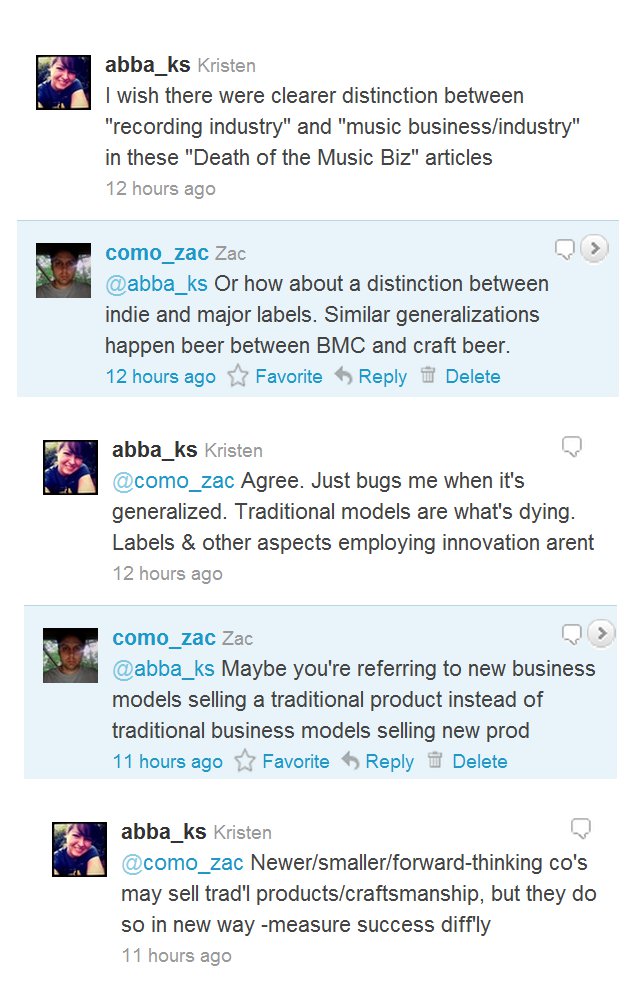
I know little if nothing about business or economics, at least not formally. That said, the following conversation happened on Twitter yesterday.
(Be sure to follow Kristen on Twitter if you’re into that sort of thing.)
There were some Tweets in between these, but you get the point. The general idea is that the media is missing the point when reporting on the failings of various industries, especially the two I obsess over. There are clear distinctions between smaller businesses who use innovation to sell traditional products and larger corporations that employ traditional methods to sell new products. Growth and sustainability happen in these smaller ventures. They sell quality over hype, depending on word-of-mouth (via social networking) and they do it in a way that’s easy to maintain.
Indie labels and craft breweries are equivalents in their respective industries. They both depend on the quality of their craft to bring them financial success. They both have large corporate entities to contend with as said corporate devils continue an incestuous practice of mergers and buy-outs. They both prefer innovation in business practices and marketing to sell quality craftsmanship. There’s a focus by both to engage intellect of the consumer by staying above the fray, never appealing to the lowest common denominator. When it comes to steady growth and sustainability, these sub-industries have the answers corporations can’t see through their greedy lens.
Take an indie like Merge. From pretty humble beginnings, this tiny label has built one of the most impressive lineups in the industry, among indies and majors. Yet, they did this while giving their artists a generous share of their album sales and limiting the growth of their label. Artists were allowed freedoms in recording and artwork as long as the tiny label could afford it. For years, they struggled out of a small office in Chapel Hill, NC. Eventually, their model which valued their relationships with artists over profits has led to a record label that actually makes a decent profit, even as the record/music industry dies a slow, painful death.
Some indies try the growth-at-all-costs model their corporate overlords use. Sub Pop – on more than one occasion – has flirted with disaster via major label marketing practices. (Interestingly, Nirvana’s major label breakthrough and a distribution deal with a major label actually saved Sub Pop from bankruptcy on separate occasions.) Sub Pop grew too big at a couple of points in the nineties, signing every band in sight. However, they stretched themselves too thin, featuring a lineup of quantity over quality. They learned their lessons, made some savvy business deals and have found a way to survive as an indie, maybe the most beloved of the sellouts.
Craft breweries have followed a similar track as indie labels. Dogfish Head is a brewery that has placed ideals over profits. They, like other breweries, have cut back on distribution while they slow growth in an attempt to maintain the quality that put Dogfish Head on the map in the first place. As far as marketing, DfH has opted to appeal to the senses as opposed to sexists. A DfH brew belongs at the table with a gourmet meal and that’s what sells. They don’t rely on ads the way Budweiser does. No. DfH’s marketing plan is to brew tasty beers. Too bad Budweiser hasn’t tried that one.
Of course, there’s been some buzz in the beer industry as A-B-InBev purchased craft beer stalwart Goose Island. While there are signs that ABI will stay out of Goose Island’s product, there are already signs that even GI will just become another marketing machine, void of substance that towers over hype. ABI purchased the rights to area codes all over. The plan is to release area code-specific versions of GI’s very popular 312 Urban Wheat Ale. This does not bode well for GI’s future as a pseudo-craft brewery enveloped in a corporate culture.
As corporations continue to push for world denomination through obscene expansion and hostile takeovers, small craft industries are thriving during tough economic times. Consumers know value and will spend their money on it when their cash flow is low. Plus, profits go much further when a company puts said profits toward employee pay and benefits, monitors slow-but-steady growth, and allows the quality of their product speak for itself.
It seems the business models of craft breweries and indie labels should be the models for all business. Not only are they successful – even with an increasing number of competitors, but they have created situations that are sustainable, benefiting everyone in their company. Will there ever be an indie or craft brewery earning as much income as their larger, corporate foes? Doubtful, but maybe that’s the point.
Benefits of Living in a Small-ish Town
OK. So, Columbia, Missouri is not the smallest of towns. There are ~100,000 people here and a major university. However, we are a two-hour drive to any major city. We’re surrounded by farmland here. Columbia is far from metropolitan.
What this means for the beer/indie nerd is that we are often shorted our desired consumables. There’s no record store. There’s no 40+tap beer bar. Many bands pass over our town in search of larger crowds (or an unwillingness to make three stops in Missouri). And many special release beers never make it to our store shelves. One can feel pretty isolated in such a town.
We often turn inward, but even that has its limitations. Music scenes ebb and flow as kids graduate and move on before a new batch arrives. We’re relegated to the same two local breweries once we’ve consumed whatever’s left on the shelves. Small towns just can’t maintain a certain level of entertainment and consumables to keep the average gentleman dabbler properly occupied.
That said, there are benefits from time to time. These benefits or advantages don’t come around often, but when they do, it can be pretty satisfying. Of course, what I’m talking about mostly pertains to beer and indie rock as other small town benefits (decent schools, nice place to raise a family, everyone knows your name, etc.) are arguably not that great or not exactly for what one is looking. The biggest advantage to living in a small town is that when someone or something comes to town, there’s a much greater chance that one will be able to take part in the festivities than if the same thing happens in a larger city.

Click for source.
Take concerts and rock shows for example. I attended a Built to Spill show a few years back, something I had grown accustomed to over the years, especially in a town the size of Columbia. If and when a band came to town, I could secure a ticket or two with little difficulty. That evening, I was chatting with friends who had previously lived in NYC. For them to see a band like Built to Spill would have taken an extreme amount of luck and $10-20 more per ticket. If a band comes to Columbia, I will be able to get a ticket or at least through the door with ease. Sometimes, there might not be that many of us in the room. It’s a definite perk.
Interestingly, this phenomena also applies to most small-to-medium-sized cities. It worked well in Columbus, OH most of the time with a few shows that sold out before I could get through to the operator or the Ticketmaster desk at Krogers. However, cities like St. Louis and Kansas City are even easier to gain access to marquee shows. Take tonight for instance. I’m heading out to Kansas City for the Wild Flag gig, something I would have difficulty doing in a larger city. The band has a ton of buzz and is touring like mad, but I suspect a ticket in NYC or Chicago is hard to come by at the moment.
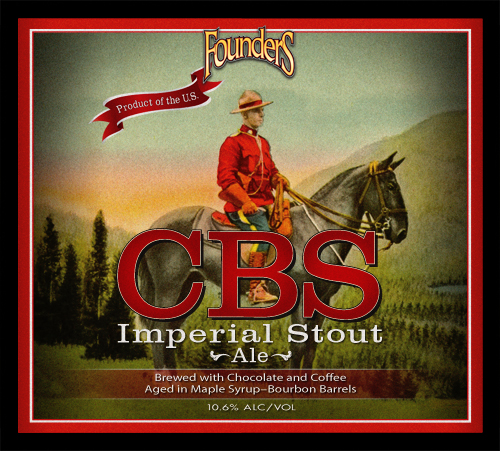
With beer, it’s all about the special releases. Like the bands who may or may not stop through town, we have to hope that distributors can find it in their hearts to allow us a case or two of the good stuff. Some beer we will never see, but some makes its way onto our shelves. Yesterday, for example, while some were getting shut-out, stores here in Columbia were quietly placing Founders Canadian Breakfast Stout on their shelves. Actually, in the case of the store around the corner from me, I was able to get a manager to go to the back and retrieve me a single bottle of the liquid gold. I figured that I was lucky enough to get one bottle and would leave the rest for others. It really was that easy to get my hands on a bottle of what is turning out to be a super-rare beer. There was no mad rush, no lines, no crashing computers.
I will complain a lot about the seclusion of living in this town, but I don’t ignore the benefits. When a band comes to town I wan to see, it happens. When a rare beer hits our shelves, I’ll more than likely get my hands on one. The lack of competition means that gentleman dabbling can continue despite other deficiencies in availability.
Indonesian Pirates, Hand-Cranked CD Players, and Magical Beer Chillers

Somehow, Carrie the Destroyer was cropped out of her cast picture.
After my lame attempt at filling digital space on Wednesday, I figured that I would go with the suggestion that provided the best chance to write the most epic[1] Building International Coalitions Through Beer and Pavement post ever. Then, I read the suggestions and decided to go with Carrie’s second suggestion anyway:
You are on a cruise ship that gets ambushed by Indonesian pirates. You gave them a watch so they will let you live, but they are going to deposit you on an island with a machete, a hand cranked cd-player and a magic eternally chilly beer cooler that automatically refills when you run out–the only catch is that this magical beer chiller can only replenish the supply of 3 beers. They tell you that you may take only three albums with you. There is a good chance you might be stuck on this island for the rest of eternity. What 3 beers and what 3 albums would you choose to be on the hot, possibly enchanted, uninhabited island with?
I will get to most of the other suggestions eventually, but this is where I’ll begin. That said, expect another top-5 on Monday. Now, on with the exercise…
There are several factors to consider when choosing may three albums. First of all, I’m changing the rules so that it’s not a hand-cranked CD player and is instead a hand-cranked phonograph player. Just because I’m stuck alone on a deserted island doesn’t mean I won’t want to hear the warm crackle of some vinyl. That said, these three records better be so good that I won’t mind hand-cranking for my tunes, severely limiting my dance time.
Another factor to consider is the versatility of the music. My three favorite records might not be good for all occasions. What if I invite over a few head hunters for dinner and want some nice mood music? What if the party gets wild and I need music that we can thrash and dance to while cutting off the heads of our meal? What if we all enter a cannibal-induced coma requiring us to relax a bit? What if I get lucky[2]? I need a soundtrack that meets many needs.
All that is true, but it has to be music with which I’ll never grow tired. We’re talking potentially an eternity. I have to be prepared. So, I picked mainly music from my favorite time period and favorite non-genre: 90’s indie rock.
- Crooked Rain, Crooked Rain by Pavement – I go back and forth whether this is my favorite Pavement album. It does fit the criteria I’ve laid out in that I love this record, it has a song for every situation, and I will never grow tired of it.
- Exile in Guyville by Liz Phair – I, like most men my age, love the idea of Liz Phair on Guyville. We like that she’s adventurous and just looking for a sensitive guy[3] and we think we can save her. Luckily, the reality of Liz Phair isn’t so appealing. Still, this is a great record that is fixed into my eternal top five or ten albums.
- Perfect from Now On by Built to Spill – I will need mood music that will also feed my anger and blood lust[4]. This record can do both and is really good.
Again, this might not be my top-3 albums of all-time[5], but they fit the criteria best. I’m also not trying to over-think this or – as I like to say – out-think the room. The goal was to pick three albums to take with me on a deserted island. Done. Easy. The beer portion of this post won’t be as easy.
The limitations are an unlimited supply of three different beers[6]. I figure one of those beers could be a beer one could drink all day long, a “sessionable” beer, if you will. There should also be a beer that will get me schnockered with just a few sips. I will need more bang for my buck. And when drinking the same thing all day or getting wasted is not my thing, I will need something I will really enjoy drinking.
Then, there’s the issue of style. I tend to prefer American craft styles over all others. So, that eliminates the imports. It’s a tough sacrifice, but I think that I’ll manage. Styles I like are Saisons, imperial stouts, sours, and IPA/DIPA’s. There are other styles I like, but these are the ones I generally reach for. The challenge will be to find three beers that fulfill my four (or five preferred styles).
I think I know what to do…
- Surly Furious – This IPA fulfills many needs. For one, it’s a hefty IPA that makes the DIPA unnecessary. Bitterness and citrus comes in a can, a very useful container on an island.
- Bell’s Expedition Stout – This is a case of me filling a need with a favorite. It’s boozy and sweet and ages well if need be. There was a temptation not to include an imperial stout since deserted islands tend to be tropical[7], but I decided to make sure that this flavor profile was covered.
- New Glarus Belgian Red – I was so going to go with a Saison or some extreme Russian River sour, but I thought about what this sort of beer can do. I decided that I needed a beer that fulfilled the sour/tart flavor profile while possibly providing an alternative that doesn’t taste so much like beer. Plus, this is a relatively hard-to-get beer[8]. Why not insure that I have an endless supply of a rare beer only sold in Wisconsin?
Notes:
1Can I now tell you how much I despise the over/misuse of the word “epic?” I fucking loath the way this word is used in everyday conversation and especially online. Now, I no longer can use the term “epic” to describe a Built to Spill jam or a magnificently huge DIPA. The word has lost all meaning thanks to the improper overuse of the word. Thanks.
2Is it me or did this post just get kinda creepy?
3To fuck. I just went creepy again.
4For wild boar. Nothing creepy. A man has to eat. This all brings new meaning to “I would hurt a fly.”
5However, I suspect all three are in my top-10, if not top-5.
6Can limitations be unlimited?
7Particularly those frequented by Indonesian pirates and their kidnapped victims.
8Although, one is sitting in my cellar at this very moment. It’s a good thing I know people who head to Wisconsin on a fairly regular basis.
A New, Looser Interpretation of Terroir

Terroir comes from the word terre “land”. It was originally a French term in wine, coffee and tea used to denote the special characteristics that the geography, geology and climate of a certain place bestowed upon particular varieties.
Or so says some guy on Wikipedia. Terroir is one of those things the wine world tries desperately to claim as all their own. However, I’d argue that a more nuanced, progressive interpretation of the concept allows room for many other things. Even the Wikipedia entry hints at the possibility of terroir in things such as coffee or tea. I’d argue there’s terroir in everything, but for the purposes of this blog, I’ll focus on the terroir in craft beer and music.
Honestly, I’m not really sure how wine can claim terroir and beer can’t. In fact, local agricultural and environmental factors may play a larger role in the character of a beer than wine since beer requires so many more ingredients. Sure, in modern production, wine more often than beer sticks to regional factors in creating flavor, but there are breweries who use only local products to produce their beverage that can’t be discounted.
That said, the original concept was to divide regions by the flavor profiles they produced in wine. A newer, more global take on this idea may look at the characteristics of various locales on the same product. For example, a beer produced in Colorado might use hops from the Pacific Northwest, Belgain yeast, barley from Canada, and local water to create something that recalls all of these regions. Sure, to the traditionalist, this might not be a case of terroir. However, I’d argue that the unique characteristics of each ingredient combines to make something hard to duplicate.
Maybe that doesn’t work for your understanding of terroir. What about the ability of humans to import all the ingredients of a region to create something that tastes and smells just as it would had it been brewed closer to its origin? In earlier discussions on this blog, I mentioned how engineering and brewing know-how can often allow a brewery to easily recreate an illusion of terroir with little regard to location.
Lost in all of this is the idea that humans can be a part of terroir. Literally, terroir refers to the land. However, this has been generally understood to include the water, climate, and other local factors. So, why not the people? They too are influenced by local factors and bring cultural perspectives to craft that can be unique to a particular terroir. People have to be considered whether you have a strict understanding or terroir or not.
At this point, I get that my interpretation may be too loose, too deconstructed, post-modern for your tastes, but I make similar arguments for many traditions and constructs beyond brewing (and music). For example, English is an evolving language that reinvents itself constantly, inventing new words, spellings, and conventions at every turn. The ideas or art, marriage, race, or the role of government are changing constantly. So, why can’t we adjust our idea of terroir to match the global times in which we live?
Now that I’ve cleared that up, I’d like to move on to terroir in music. Terroir, IMO, manifests itself in two ways when it comes to popular music. First, there’s the scene. There was a reason all the major labels flocked to Seattle 20 years ago. They all wanted a piece of that grungy terroir. Second, bands take on the terroir of a place when they write and/or record in a particular place. Why else would bands opt to record in Memphis or Chicago?
The music scene is an indie thing. Corporate leaches try as they may to capture the excitement of a thriving rock scene, but they’re often three or four years too late. Bands in scenes feed off each other, encourage one another, and often influence each other’s sound. There’s a reason most bands in Brooklyn sound like the Walkmen. Those aforementioned gunge bands all had a similar aesthetic even if they were decidedly different bands. I still get confused when I hear the opening bars to any Chicago band from just before the turn of the century. These scenes represent a very human, inorganically organic terroir like one can never find in wine.
Eventually, bands look to capture a sound that’s influenced them or turned them on. Beirut is a perfect example of a “band” that takes the influences of the road with it. Whether it be Gypsy music, French pop, or Mexican mariachi, Beirut has adopted each of these sounds as its own. (Although, it sounds as if the new one breaks from this. Stay tuned.) Another example is when a band like Pavement (among many, many others from the era) headed down to Memphis to recorded at the venerable Easley Studios, providing a certain amount of smoked BBQ and southern comfort not usually attained in northern cities.
Anything contains a certain amount of terroir. For me, terroir is a flavor or sound that can only be produced by the necessary ingredients from various locales. I don’t really care if it’s all from one location or whether it comes from all over. The end result is what matters. And within that beer or between the notes of a record, you can sense the regional influence. It’s that funk from Belgian yeast strands or the steel guitar from a month in Bluegrass country. Terroir is the undeniable piney character of a Northwestern hop or the grittiness of an album recorded in Manhattan.
I prefer not to be held down by tradition. Building International Coalitions Through Beer and Pavement is about redefining the world to better grasp humanity and the enjoyment of such things as craft beer and indie rock. If this blog has a bit of terroir, that might be it. Now, you should add your terroir to the mix and give me your take. Have I bastardized a concept that should remain unchanged or have I challenged constructs that needed challenging.
Or should I write about something else? Expect another top-5 on Monday. Cheers!
Top 5 for August 22, 2011
I feel like there topics that slip through the cracks now and again that I don’t always have time to post. I might address them in my Twitter feed or some other social media outlet, but they fail to get proper treatment here at the coalition. This is where the top-5 list comes in. The easiest kind of post for a blogger to write is the list and this new semi-regular feature will allow me to hit those things that were passed up for this sort of thing.
That said, consider this to be the first in the series of top-5’s. Don’t expect this to be a list of five records that or five brewers who kinds of lists. This is more like those lame lists editors stick in magazines to fill space. None of the items have much to do with the other except that they all appear here, in the same list. If any of these topics need further development, comment and I’ll try to get back to them, but no promises.
1. The California IPA
This is old news, but few people still discuss the merits of the West Coast IPA over other IPA’s and DIPA’s. I have enjoyed several straight-up IPA’s from the west coast and have enjoyed what they have to offer. There isn’t the booze of the typical DIPA or the syrup-ness of the Midwestern IPA or the overly hoppy characteristic of the East Coast IPA. No, the West Coast IPA is crisp, clear, dry…It may be one of the most beautiful beers there is. It’s often lost as it’s not that big and boozy, but IPA’s from the left coast were many of the beers that turned so many of us on to craft beer in the first place.
2. Stephen Malkmus
With Malk’s fifth album, Mirror Traffic, coming out this week, I have been devouring interviews and his entire discography for the past week. There’s a lot to digest before this record arrives at my front door and I let you all know what I think. What I’m rediscovering is that Malk’s work since Pavement has continued to develop. There’s more to the man than his role as father of indie rock.
3. Discoveries in Richmond, VA
I was in Richmond, VA this past week and made several unexpected discoveries. First, I found a Vietnamese restaurant called Mekong that specializes in craft beer. I showed up for some Pho and found that Mekong was celebrating their 16th year in business with a tap-takeover by Stillwater. For the second time this summer, I was able to hang out with Stillwater’s Brian Strumke. There, I was able to try several Stillwater brews, particularly the barrel-aged Stateside Saison and the Cellar Door from a cask. It was a chance reunion, but I nice way to spend an evening in a strange town with a new friend. (Admittedly, “friend” might be too strong a word, but acquaintance isn’t quite accurate either. Facebook friend? Two-time drinking partner? Stalker and stalkee?)
Other things I stumbled upon by chance included a few nice records in Richmond record stores, a brewery that will be up and running in the next month, and a nice little restaurant featuring a decent craft beer list as well as some expertly prepared eats. Be sure to check out Deep Groove Records, Hardywood Park Craft Brewery, and Magpie the next time you’re in Richmond. Deep Groove is the ideal record shop with loads of quality finds, record players for testing the vinyl, and a knowledgeable owner. Hardywood doesn’t even have beer to sell just yet, but from the looks of their website and the brief chat I had with one of their owners, I can tell they’ll do craft beer right. A guy at Hardywood sent me Magpie’s way and I’m glad he did. Magpie is a nice place on the corner that served me this phenomenally-prepared fish (can’t remember the variety) over a bed of bok-choy and gnocchi. Best meal I’ve had since returning from Spain.
4. I just read the greatest single review of an album and it was a novel.
It took me a while, but I finished Camden Joy’s semi-schizophrenic first novel, The Last Rock Star Book Or Liz Phair, A Rant. It’s not really a novel at all. Rather, I consider this book to be the most complete and obtuse record review of all-time. The man wrote a story about a fictional self who stalks Liz Phair (and/or his ex-girlfriend), blows up things in his boring hometown in Iowa that’s best known for the airliners that constantly encircle the town, and deals with the fact that his girlfriend may be the illegitimate daughter of the Rolling Stones’ Brian Jones. Through all this, Joy gives the best reading of Exile in Guyville I’ve ever read or considered. He nails the cultural importance of that album and places it into its proper context of rock history.
5. Terroir.
I read this article about terroir which is a French word that suggests things like wine or tea carry with them characteristics of the land from which they come. The article was in a beer magazine that makes the argument that beer also possesses terroir and I believe this to be true. There’s even the possibility that the people who produce such things also provide a bit of terroir to their concoctions. This idea made me think long and hard about how terroir plays out in music. Oh, there will be more to say about this in a forthcoming post, but know for now that the idea of terrior is on my mind and in my top-5.
What’s your current top-5 look like? Do you want to hear more about any of these? Do you think it’s okay to stalk Liz Phair? Does this explain her notoriously inconsistent stage fright? Should this post have garnered some footnotes?
Grab Bag
I thought I was going to have many new posts for you, but time is running out and some of these topics won’t be as good if they’re not fresh. So, I’ll summarize some topics I was considering. They may turn into full-fledged posts on their own, but for now, they’re here. I guess.
I don’t really listen to much hip hop, nor do I listen to a ton of Shellac, but this story really intrigued me. Basically, Steve Albini (yes, that Steve Albini) called out underground hip hop up-and-comers Odd Future for being rude. More interesting than the simple fact that rock/rap stars were being assholes is the fact that they were in Barcelona (days before I arrived), a foreign country. I don’t know what this is getting at, but there’s something there. Maybe this should turn into a post on American exceptionalism. I mean, I do tend to gravitate toward American craft beer and American indie rock. Moving on…
Stephen Malkmus likes to hang out in record stores. I do as well. However, I live in a town without a good record store in which to hang. I’m not sure it’s a good idea to start up a record store in this economy or in such a climate that doesn’t seem to support independent music. So, I’m thinking there needs to be a beer shop that does what the record store used to do. Enter my next project: a beer store. I’m a long way from anything happening, but there are discussions. I may take some community classes this fall and start asking around. I already have some leads to distributors, an idea for a concept (Bottles and Cans), and a model based on a wine shop that also features a bar. There will be updates, assuming the beer bubble doesn’t burst.
Then, there’s this…
The whole idea of expecting so much more from our heroes has me intrigued. I’m thinking of music fans that expect bands to keep releasing records and tour their town every year, much like Jay Smooth’s point about Lauryn Hill. The beer community isn’t excluded from this phenomena. In fact, craft beer is worse. Beer nerds are incensed that we don’t get certain breweries distributed. When new releases come out, some are pissed that someone beat them to the final bottles in town or that the distributor didn’t send an extra case to their market. There’s a certain amount of entitlement we seem to have and it sort of ruins the enjoyment or takes away the potential of the hunt.
Still, there’s more worthy topics…
I’m still mulling over the beer blog vs. music blog post. There’s definitely a totally different beer blog scene than that of music blogs. In fact, I recently posted for the Sour Session and received a lot of feedback. Plus, any time I post on beer, there’s a spike in my numbers. It even lasts a day or two. This idea, like the others above, is only half-baked and will take some time to figure out…assuming something else doesn’t come up.
This article was shared with me and the ideas within basically encapsulate my entire record collection and/or aesthetic preference. Of all these, this one will deserve the closest look, but I may have to buy the book first.
And finally, I will be doing some sort of post for the 20th(!) anniversary of Nevermind. My entire worldview may have changed at that moment. Of course, I was 16 and doesn’t everyone’s worldview change somewhat at 16? Speaking of teenagers, Francis Bean Cobain is 19.
Oh, and grrrls covering Pavement is always a nice find. This should be worked into an addendum for that girls and Pavement post I did a while back.
Stay tuned…
Creature Comforts

Creature comforts are the things we turn to in order to help us feel at home or at ease. When we’re not into the game of chance that comes with experimentation, we turn to these experiences to help us feel grounded, whole, or just like ourselves.
Two recent conversations reminded me of this importance.
The first happened at a local punk show last week. I was sitting with a guy and all we could talk about was music from the nineties, especially music from southwestern Ohio where we both originated. Earlier that same day, I had listened to The Afghan Whigs’ Gentleman and Liz Phair’s Exile in Guyville, two all-time favorites I often turn to when nothing new suits my mood.
This music qualifies as a creature comfort. Time and time again, we turn to “comfort music” to satisfy that need to feel at home. If I’m feeling ill at ease, I’ll put on Pavement, Yo La Tengo, or Swearing at Motorists (among others). This music relaxes me or settles anxieties within. Inventions like iPods has made this easier, but I’ve always carried around at least a few old standbys just in case. Sometimes we call this being “stuck in a rut,” but I prefer to look at it as turning to old standbys for inspiration instead wasting large amounts of energy searching for the next big thing.
Like music, beer offers us comforts we shouldn’t forget. It’s Just Booze Dancing… did a review on Stone IPA and called it a “comfort beer.” A comfort beer is that beer you turn to when no other option seems tempting. You go with a comfort beer because you know it will be good.
My list of comfort beers is long. There’s Bell’s Two-Hearted Ale, Boulevard Tank 7, Boulevard Single-Wide, Schlafly APA, Arrogant Bastard, or that same Stone IPA IJBD… also cited. It can depend on the context as well. I’ll go for a Two-Hearted anywhere, but I know Tank 7 is always available at one bar and Single-Wide at a burger joint I frequent. APA is everywhere. Punk and rock clubs are now featuring lots of Stone. I suppose they like the gargoyle imagery, but I’m thankful either way.
Whatever the context or beer, comfort beers are nice to find, because you know what you’re getting and with what they’ll pair best. You don’t have to worry about a beer not meeting expectations or being something you didn’t want. The comfort beer is good every time.
While these creature comforts are good for relieving our anxieties and making us feel at home, they can be limiting. If I listen to nothing but Pavement, I might miss out on something new. Ditto if I drink nothing but Two-Hearted Ale. This is where the “rut” phrase comes in. You don’t want to be stuck in a rut and never venture out beyond your comfort zone. That’s when we miss out on life.
So, the creature comforts must be used wisely. I haven’t heard a new record in weeks that I really love, but the reissue of Archers of Loaf’s Icky Mettle just arrived in the mail and I’m pretty stoked to listen to that great record again. I just had an Oberon with my dinner, another comfort beer of mine. There’s time for this, but when something new comes along, I’m ready.
Gentleman Dabbler

In the August Spin[1], Stephen Malkmus shows off his living room. At some point, he describes his record collection…
I have all kinds of weird records that I could talk about – not as many as deep collectors, but as a gentleman dabbler, I have some stuff.
The part of that quote that caught my attention was the term “gentleman dabbler,” a term that seems to refer to someone who is experienced and knowledgeable on a particular topic but not as much as the “experts” of said topic. A gentleman dabbler has a nice collection with some unique pieces. His knowledge is vast enough to know what’s good and what isn’t, but it – like his collection is not comprehensive.
Take Malk’s record collection. It would be hard to believe that someone who has been in the business as long as Stephen Malkmus has doesn’t know a thing or two about records. However, he openly admits that he’s no completest record snob. Unlike Thurston Moore[2], Malk can openly admit that he doesn’t own every record.
It is tough to admit that one doesn’t own every essential record or hasn’t tried every beer when others look toward someone for blanket consciousness. Let’s imagine that someone publishes a blog on a subject…or two. Should he be required to know everything about those subjects? I don’t think so. It’s not possible.
The gentleman dabbler allows for holes in knowledge base or collections. These holes allow for learning and discussion. I feel as though I am a gentleman dabbler. No one comes to this blog for research purposes or expertise[3]. They come here for entertainment and discussion. If you want expertise, you’ll look elsewhere.
That said, I struggle to fit into the beer blogosphere. Anyone can write a music blog. We give our opinions with varying degrees of knowledge. On beer blogs, a certain amount of expertise is expected. This is troubling as I get a lot more attention for my beer posts than I do for music. Luckily, most people have been kind.
So, keep in mind that this blog is for the gentleman dabbler. I dabble in indie rock. I dabble in craft beer and home brewing. This is not a place for expertise. This is a place for discussion and entertainment. Thanks for dabbling with me. There’s more to come…
Notes:
1Yes, I read an issue of Spin. I had to fly this past weekend and left my book at home. This was the best choice on the airport magazine rack. Spin is my generation’s Rolling Stone. That should tell you all you need to know.
2The scope of Moore’s collection is legendary. He only keeps a small portion in his apartment, but there is a storage space somewhere that would be every indie geek’s wet dream.
2Well, except for poorly written SPAMbot messages I get from time to time. Something like: “I so hapy I find you blog. It will help with a reserch project I must compete. Keep up the good wok!”
Gypsies
The gypsy is alive and well my friends. No, I’m not talking about those who wander southern and eastern Europe in search of an easy mark. The kind of gypsy to which I’m referring is that of the craft beer and indie rock worlds. Throughout those scenes, there are examples of loner craftsman wandering between breweries and bands and creating product that defies typical industry definitions.
As is usual with these sorts of things, the indie rock gypsy is way ahead of the the craft beer variety. Musicians have been using monikers normally reserved for bands of two or more people for projects with revolving members. The freedom to make all the major creative decisions for a band without worry of the band breaking down has to be a plus. And when they want to pick up and move, there are no band members holding them back. Then, when there is a creative problem to solve, they can call on hired guns to figure them out.
Take Bright Eyes for one. BE is basically Conor Oberst (later to include Mike Mogis) and whichever friends he could round up to fill spots on his roster. His sound and dynamic have generally stayed constant, but Oberst is able to create something new each time out by simply adding a few pieces while replacing others. Oberst could have gone it alone as a solo artist (which has done and probably will continue to do), but he must have liked the comforts and support a band provides. Fewer bands are as tight as an Oberst-led group and there always appears to be a great chemistry. As a gypsy, Oberst was able to move his operation to Brooklyn from Omaha without skipping a beat. Bright Eyes was not the first ever or only gypsy act in indie rock, but it has been an extremely successful one.
Interestingly, Brian Strumke, gypsy brewer of Stillwater Artisanal Ales, revealed to me that he is a big Bright Eyes fan, but their connection as gypsies in their fields don’t end there. Both have stayed true to their hometowns. Strumke brews in Baltimore and Oberst has done most of his work in Omaha. Both have traveled to “meccas” in order to continue their crafts with some Stillwater beers being brewed in Belgium and a Bright Eyes album or two written and recorded in Brooklyn. Both men have honed their crafts into something unique that often defies categorization while still giving a nod to their influences.
The gypsy is able to break free from the constraints and tradition of his craft. The typical indie rocker is stuck with the band structure that determines how many parts to consider in every song and even how many seats to provide in the tour van. Your average brewer must consider the additional costs of running and often upgrading brewing facilities. The gypsy is not bothered by either. His band can take any shape. He can brew in this brewery or travel overseas to brew at another. The gypsy is without the typical worries that dog their more sedentary counterparts.
And why is this gypsy-fication of indie rock and craft beer on the rise? Besides the freedoms mentioned above, we live in a world that is simply more conducive to the gypsy approach. For one, we are a more global society. Due to decades of migration and multicultural educational initiative, we no longer live in a …. society. There’s a reason American brewers make Belgian styles and popular music demonstrates influences from all over the globe. Secondly, technological advancements have made it possible to coordinate projects in multiple locations. Conor Oberst can work in Brooklyn while his Omaha label Team Love GM lives here in Columbia. Brewers can easily participate in beer scenes all over thanks to social media. The world is too small for these creative types to stay in one place. Bands and breweries will just keep them down.
It’s an interesting development that has produced some pretty great results. Below are a few other gypsies I admire.
- Crooked Fingers is the “band” name Eric Bachman (Archers of Loaf) uses. He lives out of vans and people’s couches, but he finds time to round up some players, record records, and hit the road. What started out as a side project of woe has turned into a great bar band, no matter who’s backing Bachman.
- Pretty Things Beer & Ale Project is one of the most sought after breweries in the scene right now. I don’t know all their particulars, but they make some artful brews and incorporate a nose for design.
- Bon Iver started out as Justin Vernon, fresh from band and girl breakups, heading out to a Wisconsin cabin one winter to record one of the most textured and heartfelt records of this century. He seems to have a regular touring band these days, but no one questions who or what Bon Iver actually is.
- Mikkeller is the gypsy from Copenhagen we American beer geeks adore. Not surprisingly, he has a connection to Stillwater as they have collaborated on several brews, some yet to be released.
Obsession
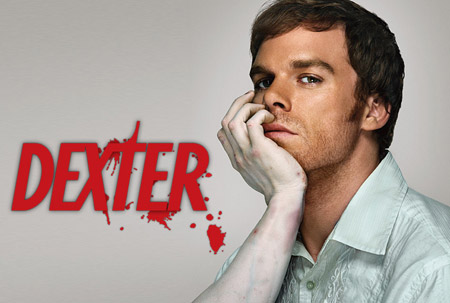
I am currently hooked on the show Dexter. I don’t watch a ton of TV and tend to wait for things to come out on DVD or some “free” service online just to see if it has staying power. For those who are not familiar, Dexter is a forensic investigator who specializes in blood splatters by day and a serial killer who only kills proven murders by night. He is consumed with a need to kill and a need to seek justice.
There are also two books in my rotation at the moment. John Sellers’ excellent memoir about his dad’s fixation with snakes lies half-read on my iPhone. Also, I am reading a novel by famed rock manifesto poster Camden Joy called The Last Rock Star Book: Or Liz Phair, a Rant. In Joy’s “fictionalized” piece, his research of a certain nineties indie starlet begins to get crossed with his infatuation with loves and dirty deeds in his past.
What all these pieces have in common is obsession. Dexter obsesses over every kill. Sellers’ dad obsessed over a particular variety of snake found in a Michigan swamp to the detriment of his marriage and relationship with his kids. In Joy’s book, the narrator, also named Camden Joy, begins to blur his obsessions with his current assignment to hunt down Liz Phair, all the while, he writes what has to be the longest record review in history. I mean, it’s an entire book.
Obsession takes over our lives. It does mine. Take the subjects of this blog. I have two obsessions that never seem to leave me alone. All I can think of is which record is coming in the mail this week or how we’ll work out babysitting for tonight’s Fleet Foxes show. The beer obsession is trickier in that it comes off as if I’m an alcoholic. I will admit to having one or two beers too many, but this stems more from wanting to try more beers, not to get drunk. My cellar is nearly busting at the seams and I’m having to make room for more homebrew as well as “shipments” from out of state. My bank account has taken a hit from both, but it may be my attention that takes the biggest hit.
Saturday was not one of my finest moments in beer drinking. It was near 100 degrees and I attended a picnic with my beer club. A few high ABV sips later, I was not in great shape and all due to my obsession to try as many rare beers as possible. The episode made me rethink some of my beer consumption (along with my declining health) and I wondered if I could give up such an obsession. The same would go for the records and the concerts or even this blog.
Luckily, these are just obsessions and not addictions. We obsess over things we enjoy or things that motivate us, but we don’t die from wanting them. If I quit any of my obsessions, I’ll be alright. There was a time I never thought I’d quit buying baseball cards, but I survived that too.
So, the obsession with indie rock and craft beer rages on. These are tough things to give up. And now that I can’t stop watching Dexter or have two books I’m enjoying, you can just add it to the list.


 Beer and Pavement
leave a comment