Why We Hate Geeks, Nerds, and Snobs
That’s right. I’m in-favor of the Oxford comma and I’m back from the dead.
I could have easily added connoisseur to the title, but that’s been covered already. Regardless, we hate them all, even if we are geeks, nerds, or snobs ourselves about beer, indie rock, or whatever. There are things we…er….they do and say that cause us to reject their ideas of beer and music. Although they are extremely knowledgeable in whatever special interest, we tune them out as to listen to them sucks all the fun out of something that should be enjoyed by all. Some acknowledge their own snobbery and are more accepting of others. However, most of us don’t like being told how to enjoy a good beer or an album.
Below are the ten things geeks, nerds, snobs, and connoisseurs do that makes it hard to take their advice and opinions on beer and indie rock seriously.
10. It was always better way-back-when.
Pavement was so much better on their Slanted and Enchanted tour than their reunion tour last summer. OR The ’08 120 Minute IPA was far superior to this year’s batch…For those who have discovered a band or beer just recently, there’s no way we can know what it was like to experience either when in their prime. It’s an unfair detail to mention in conversation. Age does not mean one has experienced all that is worth experiencing, particularly if you’re still in-search of white whales.
9. “Yeah, that’s nice, but have you experienced…”
It doesn’t matter what cool story you can bring to the table, the “expert” will always have one to top yours. I loved the Yo La Tengo show last month, but there are lots of people who thought the variation they saw on the spinning wheel was superior. Maybe. Why can’t both experiences be great? Why is a beer on tap automatically a better tasting experience than from the bottle?
8. No dialogue, just references.
This one is an epidemic for my generation. We don’t have conversations these days. We make pop culture references as way to make some meaning or connection in our lives. This practice is particularly bad when beer nerds and indie geeks “discuss” their tastes. Sea and Cake. Joan of Arc. Coctails. Rachels… La Folie. Russian River Supplication. Pliny. Dreadnaught.
7. Name-dropping when you’re not on a first name basis with anyone of note.
I love the guys who refer to their heroes on a first-name basis because they spoke to a guy at the merch booth or told a brewer how much you loved his beer. I met Brian Strumke of Stillwater Artisanal Ales at a bar in D.C. earlier this week. We chatted for while, we friended each other Facebook, but I don’t know that I’ll talk about “Brian” as if we’re close. He was a cool guy and I couldn’t resist mentioning him in this post, but our conversation doesn’t give me any more insight into craft beer than you may have.
6. Although that was great, I know how it could have been better, epic even.
You’re out, enjoying one of your favorite bands when your connoisseur buddy turns and says something like “This would have been waaaay better had they just played ‘South Carolina.'” Maybe, but they didn’t. Why ruin a good time by focusing on what didn’t happen?
5. “What do you think? I hate it.”
Ever been asked by a friend or acquaintance whether you liked a beer or were digging a band on stage and when you say you do like it, your partner proceeds to explain why this beer is infected or the band is completely off. Instead of offering his opinion first, he tests you to see whether you’re worthy or not and then details how wrong and ignorant you are.
4. “Have I told you this before?”
Snobs love to hear themselves talk and a big part of that talk is the one story he tells you over and over like it’s so amazing that you grow more impressed with every new telling. I don’t care that you saw Elliott Smith during his Either/Or days. Wow, great. You’ve been to Russian River and tried every beer on the sampler tray. It gets so bad that you start to think that this is the only thing your snobby friend has ever done and does that really qualify him as a snob?
3. Picking apart every last detail until enjoyment is impossible.
You’re sitting there, sipping on this excellent IPA, and watching the hottest band on Pitchfork. In one ear, you have your buddy explaining why the hop profile is out of balance with the malt bill. In the other ear, another friend is pointing out how the bassist is so drunk, he’s missing every cue. Who gives a fuck? Just enjoy the beers and show.
2. Once you come around, let’s throw out something shocking.
OK. So, you’ve figured out your discussion mate. He loves the sourest beers. He only listens to vinyl. Then, he drops the bombshell just to prove that he thinks about these things on a different level than you can comprehend or that he just knows more about everything… He loves the hop presence in a Miller Lite more than Pliny the Elder and still listens to his cassette tape of Hall & Oates’ Big Bam Boom, possibly the best album of the 80’s or so he claims. Really? Aren’t you just being ironic? Bad taste is bad taste, especially when one should know better.
1. The lecture.
Much of what’s been described above could be part of the snob’s lecture. The lecture is when your friend insists on dominating the conversation, constantly steering it to the one or two areas in which he assumes he is the most knowledgeable. There’s no listening on his part, just talking. And talking. And talking. Sure, he knows his shit, but there are other perspectives and opinions to consider in a discussion. Your opinion isn’t the only one that counts!
Of course, I resemble every one of these characteristics. I’ve done them all, but I feel I’ve been subjected to my fair share of each. Either way, I think it’s important we recognize these characteristics in anything in which we are knowledgeable experts and/or pathetic obsessives. And once we recognize the signs, we should try to avoid them and listen to others. When we see it in others, we should recognize that there’s good knowledge in arrogance and pretension.
Still, the backlash directed at beer nerds and indie geeks seems to resemble anti-intellectualism or anti-elitism that runs rampant through our political climate at the moment. These experts are valuable parts of our communities. They can connect dots and provide insight when it’s lacking. The trick is to not let that abundance of knowledge overwhelm or drown out enjoyment.
Update: Due to some developments elsewhere, I am adding an eleventh point. Since I didn’t rank the ones above, it doesn’t really matter where I stick this addendum. Once again, it should be acknowledged that I have committed many if not all of the above offenses. #11 is no different. In fact, if you follow the link at the beginning of this update, you’d see what I mean.
11. When someone doesn’t know when to stop…A new rule of thumb will be to limit myself to three comments in proving a point. In f2f situations, this could be a rule to make three points, then agree to disagree. The hated beer nerd/indie geek will not let something go. He has to have the last word, picking your argument apart, often diverting from the original statement. Normally, when I find myself in such a situation, I try to make a joke and move on. However, I recently engaged in an argument over the points made in this very post at another blog. I should have let it go, but I didn’t. In the end, I look like the ass. Of course, maybe it’s some strange consolation that my antagonist also comes off as an ass. Either way, two beer nerds arguing on a comment thread is a perfect way for said nerds to be ignored from here on out.
Special thanks goes out to Stan of Appellation Beer for linking back to this post and demonstrating an immense amount of patience and understanding. For a good read on beer and beer culture, I suggest you check out his blog immediately.
A Connoisseur
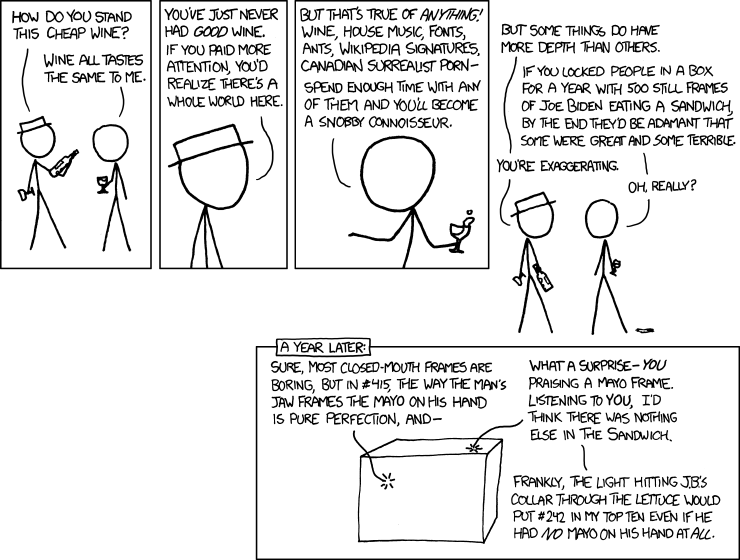
Admittedly, I sometimes get too wrapped up in my little niche. I love craft beer, a category that holds down about 5-10% of the market, depending on who you ask. I also love indie rock, a label placed on independent music that includes some non-corporately-sponsored acts but not all and is generally guitar-centric music that appeals to a small subset of music fans. These are two unique interests that I write about in this blog. What’s even more specialized is the fact that I write about the merits of only these two things.
I don’t know if this makes me a connoisseur or not. Maybe I’m just a blowhard with a blog who likes craft beer and indie rock. I pretend to know a lot because…well, I do know a lot about these two things. Not as much as some, but more than most. I guess this makes me a connoisseur as described in the comic above.
There could be more to say about many other things. In fact, I’ve often considered topics for this blog that don’t fit into either interest, but I tend to shy away from those. I’d rather write about what I write about. Still, what if I’m missing out on something else, something better?
Is craft beer really all that I’ve made it out to be? It has the uncanny ability to pair with any kind of food. There are beers perfect for every occasion. You can drink a beer with more or less alcohol, bitterness, sweetness, tartness, and some other -ness’s I’m forgetting.
What about indie rock? Is “indie rock” even a thing? It’s really a silly category of music if you get right down to it. Still, that’s what I write about.
Then, I think about the idea that anyone else could write a blog about whatever the hell they want to write about. This here blog is about indie rock and craft beer. That’s what I like. That’s what I write about.
Sorry for the filler, but I really just wanted to post the comic above and see what ideas it stirs in you all.
Nice Package

Although some are discovering the beer can and others obsess over it, the bottle is still the primary way we get our craft beer. Beer typically comes in 12 oz, 22 oz, 750 mL, and even the rare 7 oz bottle. Occasionally, one will encounter the seasonal release in a magnum bottle, but only if you plan on sharing it with a host of friends and family.
The biggest characteristic of every beer bottle is the size. Basically, how much beer do you want to drink? The traditional serving is 12 ounces, but sometimes we are faced with a 22 oz or 750 mL bomber. This either means you have a commitment to make (especially with a beer in the 9+% ABV range) or you need a friend or two. The sixer of 12 oz bottles requires another kind of commitment, one that can be spread out over time. So, there are decisions to be made when choosing a bottle size.
Take the Maharaja I opted to open the other night. I’ve been cutting back on the weeknight beer lately, but we ordered out and rented a movie on Thursday, so I figured what the hay. My sandwich included some blue cheese, meaning that I needed a big DIPA that bordered on barley wine territory to stand up to the blue cheese. Avery’s Maharaja did the trick with its mouthful of bitter and booze. However, 22 oz was more than I intended to drink. Luckily, there are tricks. I would have used a European flip-top bottle that holds 11.2 oz, but I delivered a friend some Hopslam and haven’t been able to get my bottle back. The other option I like to use is the champaign stopper. It holds in much of the carbonation and keeps enough air out to avoid oxidation. The key is to finish the beer soon, particularly an IPA/DIPA. These beers need to be consumed fresh, no matter what some think. I did so at the end of the following day.
I don’t like to do this with a bomber of beer. I’d rather open and drink a bomber in one night. Again, a fresh beer is a beer at its peak, aside from a few notable exceptions. To do this, most beer nerds know that sharing is caring. The bomber encourages this even better than a six-pack of 12 oz bottles. Sure, it’s easy to hand your buddy a 12 oz bottle from your pack, but there’s no thought put into that share. A bomber requires a careful pour. One either pours out a sampling as to allow others to try the sweet nectar inside or there is the careful aligning of glasses when there’s two or three of you. Either way, the bomber pour demonstrates a true willingness and intention to share your beer.
Besides the bottle (and the beer itself), a large part of the experience is actually the label art. Some view labels with an artistic eye. Home brewers (myself included), put their own creativity to work with their own labels. A label can entice you to try a beer or completely turn you off, even with a poor font choice. A lot of care in creating a label that grabs the consumer’s attention, paints a picture of the experience within, and promoting a brewery’s brand is taken in the design process. Sometimes, when done well enough, the label can influence opinion about what the drinker is consuming. Even the prose on a label can create a brand’s image that lasts long past a beer’s influence.
So, packaging matters.
Then, there’s the packaging in which our music comes. Granted, one should not judge a book, beer, or record by its cover, but sometimes that’s a factor. This is especially true for record covers as they often reflect the artistic vision within or are even an extended work by the artists making the music. Sadly, this is becoming less and less of a factor as uglier record covers are produced every year, possibly due to the rash of kids downloading their music and completely forgoing the package all together.
Being that I’m in my mid-thirties, I still buy records for the the purpose of owning an artifact. Ever since someone brilliantly decided to attach MP3 downloads (and even CD’s) to vinyl releases, I buy all vinyl for my collection these days. I have purchased one or two CD’s since 2009. Since then, it’s been all vinyl.
The format is for lounging, sharing. There’s the soft tones not found on tinny digital recordings. There’s a slight crackle to lend some authenticity. You have to get up and flip the record, making you physically involved in the playing process. For what it lacks in transportability, records more than make up with the more tactile aspects of music listening. It’s the full experience, not just music.
Beer offers the same in its various formats, but it generally works in the consumer’s favor whichever format is chosen. Having a beer on tap or from a cask is usually preferable, but bottle conditioning has come a long way since craft beer went extreme and home brewers became a dime a dozen. However, I’d argue the 22 ounce bomber is the vinyl of beer packaging as it promotes sharing without encouraging you to get shit-faced (too quickly)…
And this is where I lose momentum from trying to write this over a three week period. I should have left space to address specific packages I like, but I just didn’t as I got a little long-winded with this one. Surely, it’s a topic which I will explore some more in the future, but today is not my day. Any thoughts on the subject are welcome. Keep in mind that this is an unfinished post I’m trying to get out of the way so that I can write more important things about beer and Pavement.
So, for Monday, you get two lame posts in exchange for no real post. Your ignored workload thanks me.
Bottled Up
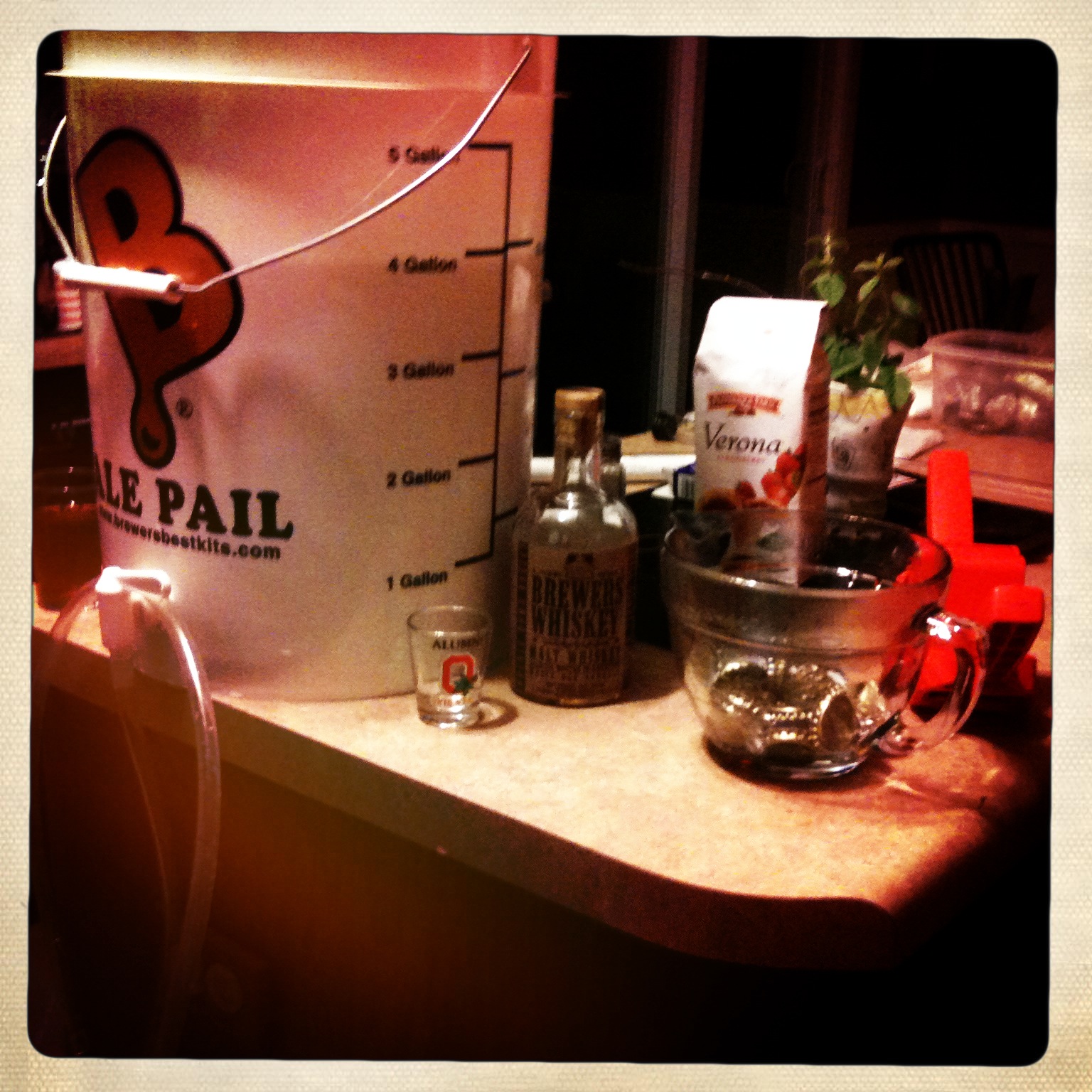
Sample, ale pail, OSU shot glass, Brewer's Whiskey by New Holland, caps, capper, etc.
Sorry. I bottled my Harnessed in Slums IPA last night instead of writing a post. The beer hit exactly where I needed it to final gravity-wise. Thursday’s New Slang Saison started bubbling late morning on Friday and has gone steadily all weekend. I’m thinking there’s enough yeast in there to get me through.
There’s one post that’s like 1/3 done (1/2 written, footnotes left to write), but I just didn’t have the energy for it. So, just gander at another Hipstamatic photo above (because I’m not a real photog with a real camera) and watch the video made especially for this beer below.
Okkervil River’s ‘I Am Very Far’ vs. Schlafly’s AIPA

I haven’t done one of these reviews in a while. In fact, I once thought I’d do them all the time, but the timing just never worked. There have been a lot of records to review recently, but beer has been neglected. The recent arrival of Okkervil River’s new album and Schlafly’s AIPA came at the perfect time for me to throw down one of these ill-conceived reviews. I won’t bore you with the old template. Instead, I’ll bore you through my prose.
Why these two in this particular challenge? Well, aside from the timing of their releases, both record and beer share a decidedly American aesthetic. And in this time when America feels particularly good about itself, celebrating things that are very American just seems like the right thing to do. Okkervil River with its take on Americana and Schlafly’s attempt to make a big IPA like every other American craft brewer connect these two loves of mine, but which one wins out in the end?
I Am Very Far is not what we’d expect from Okkervil. It’s slick without losing heart. The emphasis is on the sound and production over the words, yet it’s impeccably written. Even the emotive qualities of a typical Okkervil record are absent without the album being dull and dry. It’s a great record without being a great Okkervil River record.
When I think of their progression, I think of a few other bands with similar trajectories. Bright Eyes’ Conor Oberst is a lot like Okkervil’s Will Sheff in that they are the primary piece in bands that feature the most confessional lyrics delivered in the most recognizable of voices. However, Sheff has placed more burden on a band that has not changed as much as Bright Eyes.
My Morning Jacket also comes to mind as a similarly positioned alt.country act that tried to step out with a new sound. In my opinion, MMJ flopped with Evil Urges, an album that saw the band take a major leap in aesthetic. It may or may not have sold well and did decently with the critics, but the project seemed to dash a lot of the momentum the band was building. Conversely, Okkervil River scores a huge success that both achieves a new direction without changing who Okkervil River is.
One cannot use the phrase “wall of sound” too often when describing this album. Will Sheff put his efforts into the production end rather than weaving intricately detailed narratives throughout his songs. The lyrical content is not lacking, but it’s not the typical, literary Sheff we’re used to. Where Fleet Foxes made the leap forward by saying something pointed and specific, Okkervil River made a similar leap by withholding some information. And this slick production is surprising for a band known more for folksiness and emotion-laced tales of woe. This is not your father’s confessional emo/alt.country.
Schlafly’s American India Pale Ale takes a similar path to enjoyment. It’s not the hop bomb so many us become accustomed to when there’s a yearly release featuring a hop-forward style. The American craft brew industry prides itself on upping the IBU ante with each new release, but this beer didn’t participate in such a hoppy arms race. Nope. The ABV in this year’s batch is actually lower than last year’s and the hop bill was also altered.
The AIPA has a few peers in these parts. There’s Bell’s notorious Two Hearted Ale with it’s Centennial-induced bitterness that packs quite the wallop when fresh. There’s also cross-state rival Boulevard Single-Wide IPA and its decidedly dry finish. Although all three are in the same category, none are exactly alike. Schlafly’s AIPA is sort of sweet at first taste. There’s certainly a bitter finish, but the middle is lacking that intense strain often associated with an American IPA. As the beer warms, however, a complexity is revealed. The aroma is straight-up hop pellets (so says the homebrewer) which is always pleasing to the nose.
Schlafly’s yearly stab at an American craft beer classic may not be the most overwhelming beer out there, but it’s balance is something sorely lacking in today’s market. Although not the hop bomb I expected upon first sip, the beer expands and satisfies as it warms. It’s not your everyday American India Pale Ale, but it’s a good one nonetheless.
Both the Okkervil River album and Schlafly AIPA surprised by not meeting my American expectations, but that might have been the most American thing to do. If there’s one thing people do in this country when perfecting their craft, it is doing the unexpected with said craft, pushing expectations. Sometimes those expectations are pushed to extremes where the product no longer resembles the original. In the case of this record and this beer, the product resembles the original in ways we did not expect. Okkervil River didn’t make another emo rock opera over folksy guitars and Will Sheff whines. Schlafly didn’t overdo it with the hops. Instead, both made calculated moves in creating balanced, enjoyable final products I will continue to enjoy.
Who wins this round? I call it a draw. The lesson I learned to not expect the expected from American craft means that we all win or something equally cheesy.
*Sorry for the lack of footnotes, footnote fans. Familial duties didn’t leave time for such supplements. Maybe next time. I also had no time to read this over. Make revision/editing comments below or just tell me what you generally think.
On Pissing Contests

Pubic Domain
A good friend of mine got me to thinking about a key aspect of these obsessions I have with craft beer and indie rock: the pissing contest. I’ve addressed the pissing contest before in regards to the boys club craft beer has become, but the issue needs further development. You see, we were having a back and forth over my developing list of beliefs. One particular belief needs a condition. Here’s what I wrote:
Beer and music is something about which we can talk. Craft beer and indie rock are the best for discussion. The hours I have spent discussing the value of that man snoring in the background of a Guided by Voices song or the times at a bar I’ve spent identifying flavors in a beer are some of the best memories I own (aside from those involving my partner and daughter, of course). Obviously, I really believe in this or I wouldn’t dedicate an entire blog to the topics and where they intersect.
And when we talk about beer and music, we are mindful of the moment. We don’t mindlessly consume. Instead, we consider possibilities and different perspectives. We find meaning in these things that on the outside seem so unimportant, but a deeper look reveals lessons for life.
This belief as well as all of the beliefs on my list will be fleshed out. However, I feel there’s a point at which time the discussion[1] of craft beer and indie rock break down. It happens when a good conversation suddenly turns into a pissing contest. Some conversations are nothing but pissing contests, but no matter when the pissing begins, the contest ruins great conversation.
For the purposes of this blog and the list of beliefs I eluded to earlier, a pissing contest is the moment in any conversation where a participant interjects with something better, not really adding to the discussion. Whether it be competitiveness, jealousy, or overcompensation for something else, the pissing contest is just a way for one person to one-up the other[2]. The contest moves the discussion away from the moment and devolves into a list of accomplishments or conquests. The moment is lost forever and the discussion might as well be over.
I can demonstrate a pissing contest in the two arenas on which this blog focuses. First, imagine two dudes sitting at the bar, enjoy a beer together.
Dude 1 – Wow, this beer is really boozy
Dude 2 – Yeah, what did they say the ABV was?
Dude 1 – Like 9 or 10 percent, I think.
Dude 2 – That’s nothing. I had a Double Bastard the other day that was like 11%.
Dude 1 – Have you ever had 120 minute? I have. That thing is like 18, 19, 21%.
Dude 2 – I have and in fact I have like two oh-8’s in my cellar right now.
Dude 1 – Well, have you ever had a Sink the Bismarck? That beer will grow hair on your teeth.
And…scene.
In this example, the beer discussion really didn’t go very far as each dude one-upped the other with his beer conquests. There’s no discussion whether the booziness of the beer at hand affects their enjoyment or not. There’s no sharing a comparison of the beers they’ve had in the past. When one dude mentions a rare beer he has, there’s no offer to share. This is a pretty superficial, pretty boring conversation. The dudes’ girlfriends[3] are bored to death at this point and wondering when they can go out and have some real fun.
Now, for an example at a rock club, the night of a highly anticipated show.
Dude 1 – So, do you think they’ll play “Wake Up?”
Dude 2 – I doubt it. Pitchfork says that they’re mostly playing new stuff.
Dude 1 – Did you see them when they played at Mojo’s? It was awesome.
Dude 2 – No! For like the four-millionth time, I didn’t see them at Mojo’s[4].
Dude 1 – They did that thing where they leave the stage and play for the back of the venue.
Dude 2 – Yes, I’ve seen that a million times on line.
Dude 1 – It was awesome in person.
Dude 2 – Well, I saw them in Canada once. It was more authentic as their witty banter was all in French. I had to ask this cute French Canadian girl to translate. She did and we made out later.
In this example, the pissing contest spirals out of control until one dude obviously starts lying, even inventing a sexual encounter[5] in order to provide the final point that will make him cooler than the other dude.
In both pissing contests, the moment is lost and discussion ceases to be meaningful, if it ever even really started. Pissing contests strip the enjoyment from craft beer and indie rock, much less anything else[6]. Neither conversation produced anything more than feelings of jealousy and inadequacy in the participants. I imagine it was even worse for those who were present as their opinions or enjoyment of the moment were not a priority.
Despite my earlier rants on this subject, the pissing contest does not limit itself to one gender or class. Women partake in pissing contests as much as men[7]. The biggest difference is that men and boys are often overcompensating for a certain inadequacy[8]. Women and girls are just tired of being left out by the boys. I’m sure there’s more to it than that, but my point is that pissing contests are equal-opportunity practices for all sexes.
Class is an interesting factor. Often, out pissing the other is competition of wealth and privilege. “I can afford that fancy beer that you can’t” or “I attended more rock shows and bought more records than you did” arguments escalate the pissing contest to an arms race of whose daddy makes more money. At some point, things are reversed and the word “elitist” is tossed around. This is where the opposite happens and one celebrates PBR binges and free rock shows in basements as kryptonite to the other’s elitist pursuits[9].
A key component of hipster hatred[10] comes from the pissing contest. A hipster can never be beat as they piss cool. No matter what one brings to the PC, a hipster is one step ahead of the rest of us in knowing what’s cool. And half the time they simply make it up. Trends happen that way, but it’s impossible to keep up. Some give me a hard time for banging on hipsters all the time, but the eternal hipster pissing contest makes them pretty unbearable. The hipster pissing contest is one of perceived coolness. Quantity nor quality is considered in a hipster pissing contest. It’s all about cool, but I digress.
I too succumb to the traps of the pissing contest[11]. It used to be a common occurrence whenever I engaged a conversation about music. Someone would tell me they loved Pavement. I’d respond that I saw their last North American show[12]. Someone might mention they like Sonic Youth. I’ll respond that I once met Thurston Moore and Lee Renaldo[13]. Sometimes the pissing contest never happened if the other person was not into one-upping me, but it often did as this is what indie geeks do. “I saw them when…” and “I have [seminal LP, EP, or 7″]” conversations are just part of the culture[14].
Talking beer was once a pissing contest when we used to discuss who could drink the most without passing out[15]. That was eventually seen as the sophomoric, hyper-masculine waste of time it was[16]. Then, I met the beer equivalent of the indie geek: the craft beer geek. And the pissing contests commenced. We had this barrel-aged and that 100 IBU and that 18% ABV… It’s this constant arms race to see who can consume what first or the most. I’ve joined the contest with my own escalating cellar and bar bills. Sometimes, the enjoyment of a beer is lost when all I can think about is what I’ll have next.
The biggest problem is that we’re all so concerned with writing our names in the snow first instead of enjoying the moment[17]. We’re missing out when we focus so much on pissing contests. We can’t enjoy a beer and talk about what makes it great when our time is spent talking about all the beers that are better. There’s no way to enjoy a rock show when all we can do is brag that the band was better on the last tour. Pissing contests suck the enjoyment out of life!
The pissing contest is the adult equivalent of the childhood argument “I know you are, but what am I?” Nothing new is offered. There are no details that might provide enlightenment. It’s just another way to make yourself feel better, but it could end with you feeling worse. It’s a waste of time and does not advance humanity in any way.
So, the pissing contest is not welcome in the Coalition[18]. How can we advance our enjoyment of beer and music if we’re always trying to outdo each other?
So, when I return to my ten beliefs, let it be known that talking about craft beer and indie rock is not meant to be a pissing contest. It’s meant to be a moment with friends, enjoying life as it happens.
Notes:
1Here, the discussion, talk, or conversation really means this blog and the accompanying comments and backlinks, but it also includes the more traditional, face-to-face discussions we have every day.
2You may now start to imagine streams of urine arching into the air, each one higher than the last until we all run out of urine.
3I recognize that this is a stretch. Typically, guys who do a lot of this don’t have girlfriends. They might be married as their spouses are stuck with them, but they rarely have girlfriends. Winning a pissing contest never won me a girlfriend. I put it on hold for a while. Now, she’s stuck with me.
4I didn’t see Arcade Fire at Mojo’s and I’m still pissed every time someone brings it up.
5Sex and sexual partners are a pissing contest unto themselves. I won’t go into details as this type of PC devolves rather quickly into something so crass I’d have to change this blog to NSFW.
6Again, keep in mind that I use beer and music as a vehicle to explore many issues. These ideas have other practical, universal applications.
7Now, you should giggle at the difficulty in which a woman or girl would have in participating in an actual pissing contest. I’m not saying it’s impossible, but it’s not going to be easy.
8It’s the size of their penises. They’re worried their penises are too small, so they have to make themselves seem bigger in some way.
9Interesting how many politicians resort to the pissing contest where they try to prove how rough a life they’ve had while their opponent has had everything handed to them.
10Let’s be clear about this in a way that I’ve never been before. When I refer to “hipsters,” I am not talking about those people who are perceived to be hipster due to their attire, music, or some other thing with which Carles has an issue. The perceived hipster is not the problem. In fact, these are often the most interesting and creative people you’ll meet. “Hipster” as a derogatory term refers to a prick who only cares about being cooler than you. One cannot determine this sort of hipster without getting to know them. Assholes who just want to get laid and are willing to out-cool you at every step just to make that happen are actual hipsters, very different from the perceived hipster.
11This admission is just to show you that I recognize my own hypocrisy and how this blog often just turns into my own HTML of a pissing contest. It’s part of the human condition to prove that you’re better than everyone else. However, my point is that if we succumb to the PC, the coalition will never be built.
12I did. And I’m talking about their first last North American show in ’99. (See footnote above.)
13It’s not as cool as it sounds. I froze and couldn’t think of a damn thing to say.
14Boy, that makes indie rock sound pretty lame. It’s not really that bad, but it’s something I’ve come to expect when we talk indie.
15The worst was this dude named TJ. He would go on and on about how he finished seven…teen beers the other night. The guy actually worked on raising his tolerance by getting drunk nearly every night. He could put them away, but at what cost?
16Actually, someone finally realized how much cheaper it was to be a light-weight. Instead of drinking a six-pack in a night, you could split a sixer with a buddy and be happy.
17Now, imagine women doing this. Again, not impossible, but possibly funnier than watching dudes doing it. Just saying.
18In all truthfulness, it will still happen, but we can try out best to stay conscious and in the moment.
Revised – Ten Things I Believe…
As part of my manifesto, here are ten core beliefs I hold in regards to building coalitions of international standing through the consumption of craft and homebrewed beer and records, lots and lots of records. These beliefs are opinions I have as to the eternal connection between beer and indie rock. Bookmark this page and adopt these beliefs as your ten commandments. Or wait for successive drafts that should eventually not look so rough…
10. Craft beer and indie rock appreciate each other, but it ends there. This has to change. Beer nerds appreciate indie rock and may very well own some indie CD’s or attend an indie rock show now and again. Likewise, indie geeks splurge and order a good beer instead of opting for some PBR. Instead, what these two groups should be doing is embracing the interests of the other. Craft beer and indie rock are the equivalents of their respective industries. They are the small operations that keep DIY, locally-produced, and craft alive. That and both are meant for discerning tastes and not the mainstream. It seems craft beer and indie rock are a match made in heaven. I will always remember that the Pavement bio included a rider from one of their tours. In the rider, among many other typical requests, Pavement asked for a sixer or two of a local microbrew. This proves Pavement’s appreciation of craft beer and thus my blog is pertinent.
9. Even if you didn’t do it yourself, DIY is always the best way to go. Most craft brewers started out as homebrewers. Most indie rockers taught themselves how to play, record, or promote themselves. Both have created consumables we love in their garages and bedrooms. I try to do what I can for myself, but the next best thing are those who practice a DIY ethic or started out that way. Craft beer and indie rock are two of the most sustainable industries we have and they’re home-grown. They control growth to insure there’s enough profit for everyone to live on while keeping their standards of quality high.
8. Beer and music are meant to be paired. What pairs better with a layered, complex, thought-provoking record than a layered, complex, thought-provoking social lubricant? Beer and good music have the power to make us dance and should be practiced together.
7. On the internet, beer and music sites are only outnumbered by porn, politics, and cats. Seriously. My Google Reader is loaded with over 100 feeds from the blogs about music or beer. There’s actually more beer blogs than music. I get tired of reading critics masturbate over music and beer blogs just give more useful information in the form of beer releases and reviews. Either way, the internet is primarily loaded with dude material and nothing’s more dude than beer and indie rock.
6. Beer and Pavement are healthy obsessions with many good lessons to teach us. Craft beer teaches us that the American dream is still alive. Pavement taught us that it’s best to do your best work, call it quits, and then get back together for one more go before calling it quits again. Plus, these obsessions help one enjoy life to its fullest without losing perspective. I’ve gone to many lengths to obtain craft beer and to see Pavement play live, but in the end, it really comes down to the enjoyment of the moment. I smiled watching Pavement reunite last summer. Similarly, I can enjoy every sniff and taste of a great DIPA.
5. Labels are like breweries. Bands are individual beers. Genres are the same as beer styles. There is a taxonomy for both that align rather nicely. There is nothing I enjoy more than waiting for the next batch of Maharaja or the latest record by the Walkmen. Each release reveals something new about an old favorite. These taxonomies make it easy to place labels, breweries, genres, styles, bands, and beers in context. I like taxonomies, especially those that parallel one another.
4. Bigger is better, but not when corporations are involved. When brewers and bands push the limits, the result is almost always better. Now, “better” might not mean that the beer actually tastes better than more conventional brews. It might not mean that a record sounds better than a band’s last effort. What “better” means in this instance is that the results are discussion-worthy. A beer or record that is big is full of ingredients and is produced under unique circumstances. Sam Calagione chews on corn and spits into the beer. The Walkmen spend a weekend recreating Harry Nilsson and John Lennon’s Pussycats. These are some big, ambitious projects that either turn out good or at the very least interesting. The only time that such ambition to do things bigger in either music or beer is when a corporation is involved. Creativity is thrown out in favor of efficiency. Bigger also means quite literally that they produce more crap in a shorter amount of time. Bigger does not always translate that way for indie labels and craft breweries.
Part of this point is to separate the craft and independent industries from the corporate ones, especially those in beer and music. The corporate versions of both are the enemy. I recognize that corporations can play a part in the areas of capitol and distribution, but when it comes to quality, the enjoyment of the consumer loses out to profits. When craft brewers or indie bands get grandiose ideas, the results are meant to please or challenge their fans. When corporations get such ideas, the focus is solely on profits.
I don’t mean to knock all corporate examples. I think examples like Built To Spill or Sonic Youth making corporate money work for them are excellent models for a brewery like Goose Island. The trouble is that corporate beer buying up craft brewers is in its infancy. The only examples (Rolling Rock,Leinenkugel, Redhook, etc.) have failed miserably. They’re the Replacements of craft beer. There is nothing wrong with taking advantage of corporate assets. The trouble arises when independence is given up for unsustainable profit.
3. Friendships are based on or can be destroyed through beer and music. This isn’t usually an intense relationship based on personal preference, but acquaintances evolve into strong friendships over a shared admiration of a fine imperial stout or on a roadtrip to see a band for the first time. Conversely, friendships fade when you choose the saison and your buddy chooses the Bud Lime or when you want to listen to some Neutral Milk Hotel and he wants Limp Bizkit. These preferences do not make or break friendships completely, but they come close.
2. Beer and music are at their best when it’s all about the craft. Regardless of your taste, we can all appreciate a well-crafted product. We might not always go for craft, but we can see the value in it. Some of us are willing to pay for that craft when it’s in the form of beer. Where indie rock is concerned, we’re willing to search it out. Interestingly, the cheapest and easiest to find beers and music are not often high on craftsmanship.
1. Beer and music is something about which we can talk. Craft beer and indie rock are the best for discussion. The hours I have spent discussing the value of that man snoring in the background of a Guided by Voices song or the times at a bar I’ve spent identifying flavors in a beer are some of the best memories I own (aside from those involving my partner and daughter, of course). Obviously, I really believe in this or I wouldn’t dedicate an entire blog to the topics and where they intersect.
And when we talk about beer and music, we are mindful of the moment. We don’t mindlessly consume. Instead, we consider possibilities and different perspectives. We find meaning in these things that on the outside seem so unimportant, but a deeper look reveals lessons for life.
Those are ten things I believe about beer and music. Is there anything I should add? What would your list look like for these topics or two subjects of your choosing? As always, leave a comment or link back from your own blog. When I wrote this version, I was waiting to see what Pizza had to say, but he did not post anything as of Tuesday. I’ll update a response if it posts between then and now.
I plan to revise and repost. So, this will develop into multiple posts, stemming from this original framework. Let me see if I can address your questions, more for the revision process than to satisfy your curiosity. Feel free to respond further.
10 Things I Believe About Building International Coalitions Through Beer and Pavement
This is a first draft, meaning that I haven’t had time to clean up some wording, include specific examples, or throw in a bunch of useless footnotes. I just didn’t have time to give this the proper treatment and still insure a post for Wednesday. However, all is not lost. Look over my list and tell me where I need to beef it up with examples and footnotes. Tell me where there are holes in my beliefs, or at least the way in which I’m expressing said beliefs. Also, any suggestions for an image would be appreciated. I have an idea to do something with the Ten Commandments, but I haven’t found the right image to doctor.
As part of my manifesto, here are ten core beliefs I hold in regards to building coalitions of international standing through the consumption of craft and homebrewed beer and records, lots and lots of records. These beliefs are opinions I have as to the eternal connection between beer and indie rock. Bookmark this page and adopt these beliefs as your ten commandments.
10. Craft beer and indie rock appreciate each other, but it ends there. This has to change. Beer nerds appreciate indie rock and may very well own some indie CD’s or attend an indie rock show now and again. Likewise, indie geeks splurge and order a good beer instead of opting for some PBR. Instead, what these two groups should be doing is embracing the interests of the other. Craft beer and indie rock are the equivalents of their respective industries. They are the small operations that keep DIY, locally-produced, and craft alive. That and both are meant for discerning tastes and not the mainstream. It seems craft beer and indie rock are a match made in heaven.
9. Even if you didn’t do it yourself, DIY is always the best way to go. Most craft brewers started out as homebrewers. Most indie rockers taught themselves how to play, record, or promote themselves. Both have created consumables we love in their garages and bedrooms. I try to do what I can for myself, but the next best thing are those who practice a DIY ethic or started out that way.
8. Beer and music are meant to be paired. What pairs better with a layered, complex, thought-provoking record than a layered, complex, thought-provoking social lubricant? Beer and good music have the power to make us dance and should be practiced together.
7. On the internet, beer and music sites are only outnumbered by porn, politics, and cats. Seriously. My Google Reader is loaded with over 100 feeds from the blogs about music or beer. There’s actually more beer blogs than music. I get tired of reading critics masturbate over music and beer blogs just give more useful information in the form of beer releases and reviews. Either way, the internet is primarily loaded with dude material and nothing’s more dude than beer and indie rock.
6. Beer and Pavement are healthy obsessions with many good lessons to teach us. Craft beer teaches us that the American dream is still alive. Pavement taught us that it’s best to do your best work, call it quits, and then get back together for one more go before calling it quits again. Plus, these obsessions help one enjoy life to its fullest without losing perspective. I’ve gone to many lengths to obtain craft beer and to see Pavement play live, but in the end, it really comes down to the enjoyment of the moment. I smiled watching Pavement reunite last summer. Similarly, I can enjoy every sniff and taste of a great DIPA.
5. Labels are like breweries. Bands are individual beers. Genres are the same as beer styles. There is a taxonomy for both that align rather nicely. There is nothing I enjoy more than waiting for the next batch of Maharaja or the latest record by the Walkmen. Each release reveals something new about an old favorite. These taxonomies make it easy to place labels, breweries, genres, styles, bands, and beers in context. I like taxonomies, especially those that parallel one another.
4. Bigger is better, but not when corporations are involved. When brewers and bands push the limits, the result is almost always better. Now, “better” might not mean that the beer actually tastes better than more conventional brews. It might not mean that a record sounds better than a band’s last effort. What “better” means in this instance is that the results are discussion-worthy. A beer or record that is big is full of ingredients and is produced under unique circumstances. Sam Calagione chews on corn and spits into the beer. The Walkmen spend a weekend recreating Harry Nilsson and John Lennon’s Pussycats. These are some big, ambitious projects that either turn out good or at the very least interesting. The only time that such ambition to do things bigger in either music or beer is when a corporation is involved. Creativity is thrown out in favor of efficiency. Bigger also means quite literally that they produce more crap in a shorter amount of time. Bigger does not always translate that way for indie labels and craft breweries.
3. Friendships are based on or can be destroyed through beer and music. This isn’t usually an intense relationship based on personal preference, but acquaintances evolve into strong friendships over a shared admiration of a fine imperial stout or on a roadtrip to see a band for the first time. Conversely, friendships fade when you choose the saison and your buddy chooses the Bud Lime or when you want to listen to some Neutral Milk Hotel and he wants Limp Bizkit. These preferences do not make or break friendships completely, but they come close.
2. Beer and music are at their best when it’s all about the craft. Regardless of your taste, we can all appreciate a well-crafted product. We might not always go for craft, but we can see the value in it. Some of us are willing to pay for that craft when it’s in the form of beer. Where indie rock is concerned, we’re willing to search it out. Interestingly, the cheapest and easiest to find beers and music are not often high on craftsmanship.
1. Beer and music is something about which we can talk. Craft beer and indie rock are the best for discussion. The hours I have spent discussing the value of that man snoring in the background of a Guided by Voices song or the times at a bar I’ve spent identifying flavors in a beer are some of the best memories I own (aside from those involving my partner and daughter, of course). Obviously, I really believe in this or I wouldn’t dedicate an entire blog to the topics and where they intersect.
Those are ten things I believe about beer and music. Is there anything I should add? What would your list look like for these topics or two subjects of your choosing? As always, leave a comment or link back from your own blog.
Notes:
On Selling Out
All over the beer blogosphere Monday morning was the story that Anheuser Busch-InBev purchased Chicago’s Goose Island, a fairly popular craft brewery. The words “sell” and “out” were thrown around more than once. Such conversations reminded me of the early nineties when selling out was a bad thing for musicians. Of course, most of them did it anyway. I even wrote a pretty terrible paper on the subject for an English course I was taking[1]. Every indie band who jumped ship for a major label (and there were a lot of them back then) was scrutinized for their decision. Were they sell-outs? Why did it matter?
It was a pretty big deal to an idealistic and naive me. Of course, I had little idea of what it selling-out actually meant. I vehemently defended bands I liked as not selling-out despite huge contracts with corporate recording companies. I felt at the time that subverting the mainstream from the inside was a way to counteract taking a huge payout from corporate overlords. Then, I started to see how some indie bands were doing the same thing without compromising indie-ness by refusing to sign to major labels and sticking with the indies that gave them their first shot[2].
As I grew older, I came to realize that idealism is cool, but we’ve got to get paid eventually. For example, I wanted to make a difference in the world by working with kids, but getting paid to do that surely didn’t hurt[3]. I saw the same opportunities for bands. Some were signing major label deals, careful not no run up huge amounts of debt the way their predecessors had[4]. Other bands sold songs to movies and advertisers. At first, this turned me off, but I soon realized that between the additional exposure and guaranteed paycheck, these bands were able to extend careers, making the music I love[5].
Still, it’s not as simple as saying selling-out is bad or getting paid is good. There’s a ton of gray. Getting a huge paycheck from a faceless corporation can be good, bad, or somewhere in between. It all depends on how one handles it.
To demonstrate what I mean, the following examples show how selling out ruins or even imporves an indie band or musician[6]:
- Sonic Youth’s reputation took a huge hit when they signed to a major in 1990. After years of indie bands mostly floundering either on their own or because they had foolishly signed with a major, Sonic Youth gambled with an offer from Geffen. This moment marked the beginning of the 90’s bum-rush of the underground for the next big thing[7]. Luckily, Sonic Youth never compromised their sound and used their new platform to expose better music to more people. Even though SY had signed with a major label, they somehow maintained their indie spirit through the bands they with which chose to tour and by making some rather non-mainstream music. Today, they release records on their own label and/or indie Matador Records.
- Speaking of Matador, they, like their brothers in Seattle (Sub Pop), signed distribution deals with some majors[8]. One of those deals was with Capitol Records. One musician on Matador’s roster, Liz Phair, had built a pretty promising run of two nineties, lo-fi classics in Exile in Guyville and Whipsmart. Phair’s somewhat mediocre Whitechocolatespaceegg was co-released by the two labels[9]. Eventually, Phair made the leap to that very major…and promptly released the shittiest material of her career, pointing out that her new goal was to make some cheddar while she could[10]. Phair compromising her art to write pop tunes was certainly a bad long-term decision.
- Built to Spill developed a pretty solid following during the mid-nineties with their catchy ditties about adolescent disillusionment. Warner Bros. saw an opportunity to grab hold of a hit machine a la Weezer or Green Day or whatever one-hit wonder was topping the charts at the time[11]. Because of the band’s growing popularity and potential, the label agreed to sign them while allowing a lot of creative control. What resulted is a pretty uncompromising album in Perfect From Now On, filled with anything but three-minute insta-hits[12]. The band has continued to make music the way they want to and WB lets them.
- The story of Modest Mouse is somewhat mixed. I wouldn’t say that they’ve compromised their music for mainstream success, but their breakout hit “Float On” suggests otherwise. Still, even with their Billboard success, they found a way to make it work.
- Nirvana was basically talked into signing with Geffen because Sonic Youth sold them on the idea. Yes, Nirvana sold a shit-ton o’ records, but at what cost? Although Kurt Cobain was destined to go out the way he did, I sometimes wonder if his discomfort with the industry contributed to his ultimate demise. If you listen to Bleach and Nevermind back-to-back, it’s easy to tell that it’s the same band, but a lot of oomph was lost in the production of that second album. They got some of it back with In Utero, but the damage was done. It would have been interesting to see what Nirvana could have done had they not signed with
the devila major label.
There are plenty more examples than these, but the point still remains that selling-out has mixed results. The Goose Island deal does not have to be a bad one. We’ll have to wait and see.
Another related topic that I’ve been mulling over for while is the fact that many indie bands and craft brewers don’t need corporate money, promotion, or distribution to be successful. So, selling-out might be unnecessary, but that’s another topic for another post[13].
The key to this deal is that Goose Island was plenty successful before they sold out to ABI. They enjoyed more success when ABI took over their distribution, adding a ton of Belgian-inspired beers and expanding the Bourbon County Stout line. My suspicion is that Goose Island will be more like Sonic Youth than Liz Phair, but we’ll see.
As with bands who sign with majors, this move for GI can go well or bomb. Either way, craft beer drinkers should judge GI on their beer and not the company who purchased them. If the beer’s good, continue to drink it. If ABI wants to cut costs and the quality drops, don’t drink it. I still listen to bands who make the leap to the majors if the music is good. Interpol tried it and failed. The result is that I don’t buy Interpol records anymore. Conversely, I think the Flaming Lips’ best work (which is now most of their catalog) is on a major. Selling-out doesn’t necessarily equate failure or success. It all depends on the individual entities involved.
I for one will give Goose Island the benefit of the doubt and wait to see whether their beer stays the same, deteriorates, or even improves before I make my final assessment. However, knowing the company who bought them out, I will watch this developing situation closely.
Notes:
1Upon discovering and rereading the paper again, I found that my real thesis was more along the lines of “you’re a sell-out if you suck.” I ripped lame hair metal bands for appealing to the lowest common denominator and called them sell-outs. Meanwhile, a band like Pearl Jam was not a sell-out because…well…I liked them a lot at the time. I have no idea how I got an ‘A’ on that paper. I even think I ripped on a few of the instructor’s favorite bands along the way.
2Favorites like Pavement and Archers of Loaf come to mind. I don’t actually think Pavement received that much attention (especially after Wowee Zowee), but it’s well-documented that AoL turned down offers.
3To be honest, I was always paid to work with kids. However, at some point, I had to make the choice of public school teacher over YMCA camp staff. The pay and benefits for the former were much better than the latter.
4There are way more stories of bands who signed with majors, were forced to rent studio space and tour buses, and were left with thousands in debt that was left unpaid when the hits stopped coming. The smart bands refused using expensive studios, producers, and tour busses. Major labels are really just good for distribution and maybe promotion, but that’s it.
5It’s pretty easy to see the lasting effect of this practice. Indie bands of the eighties often fizzled out due to an inability to make a living playing tiny clubs and selling a couple hundred 7″ singles. Conversely, a lot of my heroes from the nineties have extended their careers well into the next century. I envision a day when all the bands of my college years are doing huge world tours like the Rolling Stones. It will either be amazing or totally suck.
6At this point, you might be wondering what this has to do with beer. The examples of craft brewers being bought out by corporate beer makers/promoters is a short list of mostly failures. One doesn’t have to look far to find the examples of Leinenkugel, Rolling Rock, or Red Hook to show that selling-out to corporate beer producers is a bad idea. However, I think this Goose Island deal might be different. That and I like to connect craft beer to indie rock whenever possible.
7Some like to point to Nirvana’s signing as this moment, but Nirvana was signed as a result of Sonic Youth signing. Sonic Youth was the gateway band. Nirvana blew the whole thing wide-open, but Sonic Youth’s signing was the beginning.
8In reality, indie labels signing deals with major labels better correlates with the Goose Island deal, but I didn’t have the time to research all the labels who signed deals with major labels. Basically, the ones that I know of, put out the same kind of music they always had. Some survived, but most were dropped when profits tanked. Matador and Sub Pop were able to sign deals that allowed them to continue to do what they were doing long after the majors faltered. They made it work by simply using corporate resources without adopting the corporate homogeneity.
9As was Pavement’s Brighten the Corners, easily the closest the band ever came to a cross-over album. The difference is that Pavement’s newfound willingness to appeal came off as a coincidence. The reason I say this is because the album they jointly released with Matador and Warner Bros. was Wowee Zowee, a decidedly un-mainstream-appealing record. The band never made overtures to go mainstream the way Liz Phair has.
10I don’t blame Liz Phair for selling out. She had a kid to take care of. Ironically, she had better career options as an indie rocker than she did as a pop songstress. Check Pavement’s reissue and reunion tour sales figures. Indie rock worked out for them.
11Writing a lot of catchy, three-minute punk/pop songs is usually a sure way to get signed. The only part that wouldn’t have worked out for BtS is that they have never looked the part of angst-y adolescent heartthrobs. No thirteen-year-old was going to fall for that.
12To put this into perspective, the band’s previous release contained thirteen tracks clocking in at around 46 minutes with only two over the five minute mark and the rest in the 2-4 minute range – ideal for major label releases. Perfect From Now On was 54 minutes long spread over eight tracks. The shortest tracks were 4:52 and 5:33, respectively. The other six tracks were all over six minutes.
13I am considering proposing craft beer and indie rock as models of business success that could be copied in helping our economy recover. There has to be a reason these sectors are doing well despite the failures of their respective industries. Craft beer continues to grow while overall beer sales shrink. Indie labels and bands flourish (or at least make a living) despite all the major labels crumbling around them. There’s something about small, independent businesses that are sustainable and productive for communities in ways that corporations just can’t match. This topic has legs.
Beer & Music Pairings
This was once a central focus of this blog, but I struggled to make it work. Now, I have the methodology. It’s time to pair some beer with indie rock.
(via Hot Knives)


 Beer and Pavement
26 comments